

company updates · open atelier · craft
Introducing Open Atelier: A Writing Teacher That Reads Your Book
JP LeBlanc · November 13, 2026 · 4 min read
Most of what I've written on this blog is about the habits AI prose falls into: the negation pivot, lists of three, chapters that open on the weather. Writing those posts, I kept running into the same problem from the other side. Human drafts have habits too, and a tool that only points at them leaves you knowing what's wrong and no better at fixing it the next time.
Open Atelier is my attempt at the other half. It's a new app, in beta, at openatelier.co. The line on its home page is the shortest description I have: a writing teacher that reads your book. You bring chapters. It finds what holds them back, explains why, and checks your fix.
Diagnose, learn, practice, check again
The whole product is one loop, and it runs on your own pages instead of on textbook examples. Take a line like this one:
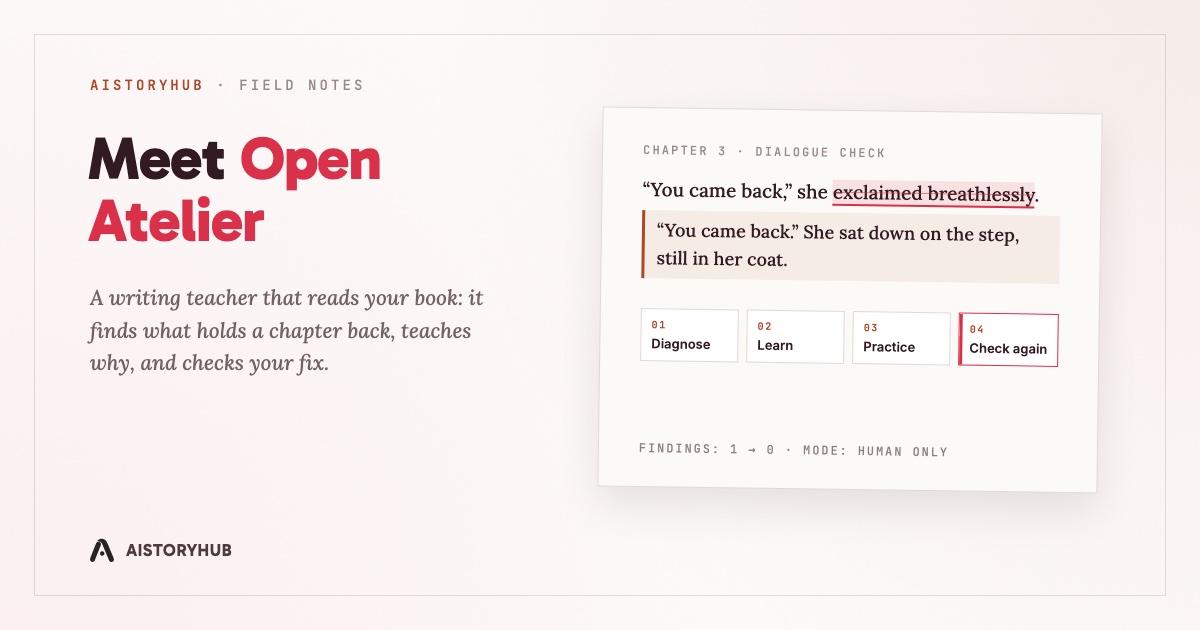
"You came back," she exclaimed breathlessly.
The chapter check flags the adverb on the tag. The finding opens a short lesson on why showy tags pull the eye off the words, with before and after examples. Then comes an exercise on that exact line, on your page: keep what it means, drop what the tag was doing, and give her something to do instead. Maybe she sits down on the step, still in her coat. Then you run the check again, and it lists what changed, finding by finding: what's gone and what's new.
There are fourteen lessons today, all free, covering dialogue tags and rhythm, filtering and holding point of view, clutter, echoes and stock phrases in prose, backstory, summary, purpose and tension in scenes, names that drift across a manuscript, and building characters. The check is tuned on published novels, so good prose draws few flags. If you've read the subtext post, the dialogue lessons will feel familiar. They come from the same place.
AI is a setting, chosen per manuscript
Open Atelier's stance on AI is one sentence: write however you write, and be truthful about how. Each manuscript has a mode.
- Human only. No model is called, ever. The check runs on rules alone. This is enforced on the server, so it holds even if something in the interface goes wrong.
- Coach. A model reads your chapter and leaves notes. The notes stay beside your text and have no way into it.
- Co-write. A model can also suggest text for a passage you choose. Only what you accept goes in, and it goes in marked as AI-generated.
You can have a Human only novel and a Co-write side project in the same account. The editor, the check, the lessons and the exercises work the same in every mode.
A record of how the words arrived
Every stretch of text keeps its source: typed in the editor, pasted, imported, written by a model and accepted, or written by a model and then edited. That last one matters. Editing AI text doesn't wash the mark off. If a publisher, an agent or a contest asks how you used AI, you can show them what you typed, what you pasted and what a model wrote.
I want to be careful about what that record is. It's a record, not proof. Anyone can retype a sentence by hand, and nothing in Open Atelier claims to verify that a person wrote something. What it does is make honesty easy for the writers who want to be honest, which I think is most of them.
How it differs from AIStoryHub
AIStoryHub is built for writing with a model. Generate PRO, Ash and the story bible are all about getting better prose out of AI and keeping it consistent, and you bring your own key to pay for it. Open Atelier starts from your pages and treats AI as optional. The things I learned here about what models get wrong in fiction went into its checks and lessons, but it's a different tool for a different question. AIStoryHub asks how to get a better draft out of a model. Open Atelier asks how you get better at drafting.
The pricing is different too. There's no bring-your-own-key. The editor, the chapter check, every lesson and the authorship record are free with no limit, because none of them call a model. Coach reads and Co-write requests do cost money to run, so they come with an allowance: a few on the free plan, and more on the Atelier plan at $21 a month or $189 a year. New accounts get seven days of Atelier with no card. Your pages are never used to train models, and manuscripts are never public or indexed.
Try it without an account
The home page has a check you can run on a scene before signing up. Paste a page of your fiction, ideally one with some dialogue, and it runs in your browser. Nothing you paste is sent anywhere, and no AI is involved. If you like what it finds, you can keep that page as your first manuscript and bring the rest. It imports from Word and Scrivener and exports to Word, EPUB and PDF whenever you want to leave.
It's a beta, so some things will break. When they do, tell me. The first chapter you bring is the most useful feedback I can get.