

craft · ai writing
"Not X, but Y": The Negation Pivot and Why Models Love It
JP LeBlanc · November 4, 2026 · 5 min read
Here are three sentences from the kind of scene a model writes when you ask for tension:
He didn't walk to the door. He strode to it. The room wasn't dark, exactly. It was dim, the way rooms get when nobody has opened the curtains in days. It wasn't anger in her eyes. It was something older.
Each sentence denies something nobody claimed. No reader assumed he was strolling. Nobody said the room was pitch black. The prose sets up a small wrong answer so it can correct it, and the correction is supposed to feel like precision.
The nonfiction cousin is easier to spot because you've seen it in a thousand LinkedIn posts: "It's not just about writing faster. It's about writing better." That exact example sits in our AI cliche corpus under contrastive negation, at red confidence, next to its sibling "not only X but also Y." In the fiction version, the setup hides inside ordinary verbs, which is why it survives editing so well.
Why models reach for it
I can't point you to a paper that proves why, so treat this as my best read after a lot of generated drafts. The pivot is the cheapest way to make a sentence feel like it found something. "He strode to the door" is a flat report. "He didn't walk to the door. He strode to it" has a beat of setup and a beat of payoff, and that beat reads as insight even when nothing was learned. A model writing toward "sounds good" gets rewarded for that shape.
It also comes from what the model read. Persuasive writing is full of correction moves. Op-eds and product pages run on "you think X, but actually Y." When fiction prompts ask for intensity, the model reaches into that drawer. Then it upgrades a synonym (walk to stride, dark to dim, smiling to smirking) and wraps the upgrade in a denial so it feels earned.
The test: does Y change what the reader understands?
Not every pivot is a tell. Some of the best lines in fiction are reversals. The rule we gave the structural critic that reads AIStoryHub's generated scenes is the most useful version I've found, so here it is plainly.
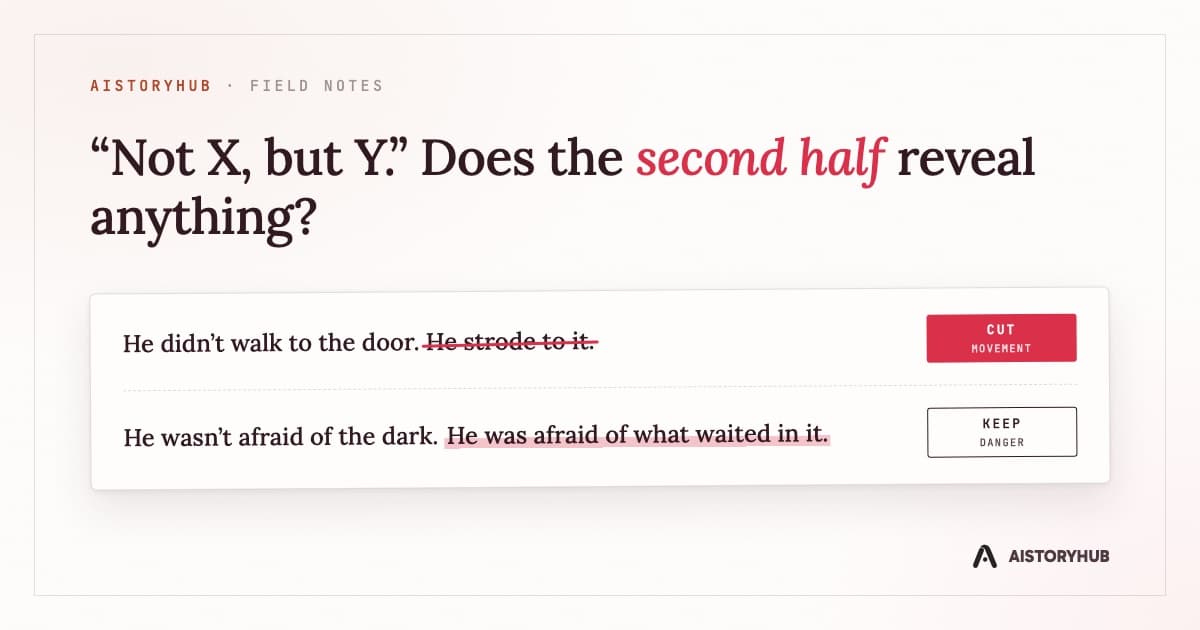
A "not X, but Y" earns its place when Y changes what the reader understands about motive, danger, or character. These stay:
- He wasn't afraid of the dark. He was afraid of what waited in it. The threat just moved. That's danger.
- She didn't hate him. She hated who she became around him. We learned something about her. That's character.
It's a tell when Y only sharpens movement, expression, or atmosphere, because then Y is a synonym in a reveal's clothes. These go:
- He didn't walk to the door, he strode to it. Movement.
- She wasn't smiling, she was smirking. Expression.
- The room wasn't dark, it was dim. Atmosphere.
Ask one question of each pivot in your draft: does the second half reveal something, or does it replace a plain word with a fancier one? Reveal, keep it. Replace, cut the setup and write the plain sentence.
Before and after
A paragraph with the habit fully loaded:
Mara didn't knock. She pounded. The hallway wasn't quiet; it was holding its breath. When Teo finally opened the door, he didn't look surprised. He looked tired, the kind of tired that has nothing to do with sleep. She hadn't come to apologize. She'd come to take back the key.
Run the test on each one. Knock to pound is movement: cut. Quiet to holding its breath is atmosphere, and a cliche besides: cut. Surprised to tired is closer, but "the kind of tired that has nothing to do with sleep" is a second stock phrase stapled to the first: cut. The last one stays. "She hadn't come to apologize. She'd come to take back the key" tells us her motive and reverses what Teo (and the reader) probably expected. It's the only pivot in the paragraph doing real work.
Mara pounded on the door with the side of her fist. Somewhere down the hall a television went quiet. Teo opened up in a T-shirt he'd clearly slept in, and he didn't say her name. She hadn't come to apologize. She'd come to take back the key.
Four pivots became one, and the one that survived hits harder because it isn't competing with three imitations of itself.
One is a move, two is a habit
Even good pivots wear out. The heuristic in our generation pipeline that looks for the fiction version (a pronoun sentence that negates an action, followed by a short sentence with the same subject doing the other thing) doesn't flag the first one it finds. It flags the second. One reversal in a scene reads as a choice. Two starts to read as a drumbeat, and by the fourth the reader can feel the next one coming, which is the opposite of what a reversal is for.
So even after you've applied the test, count the survivors per chapter. If three pivots all passed the motive, danger, or character test, pick the strongest and rewrite the other two as straight statements. "She hated who she became around him" works fine without its setup if the setup was already implied two pages earlier.
Finding them in your own draft
Search is crude here but it works. Look for n't and not, and read the sentence after each hit. You're looking for the same subject coming back immediately with the affirmative: "He didn't X. He Y'd." Also check for instead and rather at the start of a sentence. In nonfiction, search for not just, not only, and more than just.
For the nonfiction form, the fix is nearly always to delete the X. "It's about writing better" can stand alone. If X is a real position some people hold, name who holds it and argue with them directly. A denial of an imaginary opponent is filler.
What our tools catch, and what they miss
The Slop Checker matches the explicit nonfiction forms by pattern: "it's not just X, it's Y" and "not only X but also Y" both light up. The fiction form is harder. "She didn't answer. She picked up her phone" is an ordinary pair of sentences, and a regex can't tell it from "He didn't walk. He strode." Telling them apart takes reading.
That's why the fiction check lives in the generation pipeline instead. After a scene generates, a critic model reads it for structural tells, including this one, under the same motive, danger, or character rule. Spans that only upgrade a synonym get redrafted from what they were trying to say, and the redraft is kept only if nothing measurable got worse. It catches a lot. It doesn't catch everything, and it doesn't touch prose you wrote yourself.
For your own pages, the test above is faster than any tool: find the pivot, ask whether Y revealed something, and keep only the ones that did. If you want a first pass on a chapter's explicit tells before you start, paste it into the Slop Checker.