

craft · dialogue
Subtext: Writing Dialogue Where Nobody Says What They Mean
JP LeBlanc · November 10, 2026 · 5 min read
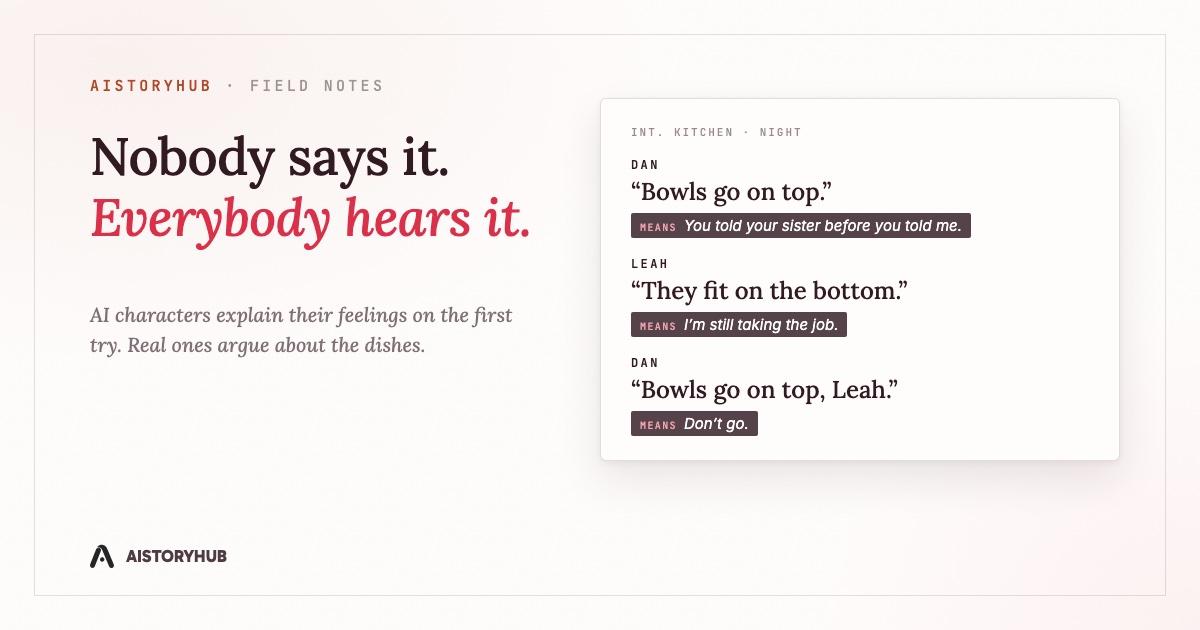
Two people are loading a dishwasher. She has just accepted a job in another city. He found out from her sister. Here's the scene the way a model usually writes it:
"I feel like you didn't trust me enough to tell me yourself," Dan said, setting down a plate.
"You're right, and I'm sorry," Leah said. "I was scared of how you'd react. This job means so much to me, but so do we."
"I just want to be part of your decisions."
Everything in it is true and none of it is dialogue. Both characters have read the scene's summary and are reciting it. People in the middle of a hurt don't usually have that much access to their own feelings, and when they do, they rarely hand it over that cleanly.
The same scene, with the subject moved:
"Bowls go on top," Dan said.
"They fit on the bottom."
"They fit. They don't get clean." He took one out and moved it. "Your sister says hi, by the way."
Leah closed the dishwasher with her hip. "When did you talk to Ruth?"
"Bowls go on top, Leah."
Nobody says job, city, or trust. The reader knows anyway, and the knowing is where the scene happens.
I covered the phrase-level version of this problem (voice laced with quiet fury, "I understand how you feel") in Why Every AI Character Talks the Same. This post is about the layer under that: what characters choose to say at all.
Why AI characters over-explain
A chat model spends most of its life being asked to be clear. Clarity is the job: answer the question, name the thing, leave nothing ambiguous. When it writes a character, that habit comes along. The character answers the question that was asked, names the emotion, gives the reason, and closes the loop. In an assistant that's a virtue. In a character it reads as someone who has been to a lot of therapy and has no inner life left to hide.
The structural critic in our generation pipeline has a name for the narration version of this: over-explained, where prose names a character's emotion and its causes instead of letting action and detail imply them. Its instruction for fixing it is a good rule for dialogue too. Keep the physical tell. Cut the diagnosis.
Five ways people avoid saying it
Think of these as moves real people make in kitchens and cars. You can borrow them on purpose.
Argue about something else. The dishwasher scene above. The fight is about bowls because bowls are safe to be right about. Choose a displaced subject that has some small, real disagreement in it, so the surface argument can carry heat without anyone admitting why.
Answer a different question. "Are you coming to Mom's on Sunday?" "I've got that thing with the car." The reader hears no. The other character hears no. Nobody had to say it, and the evasion tells us something about both of them.
Avoid one word. Pick the word the scene is about and forbid every character from saying it. A widower who can talk about the funeral catering, the weather on the day, the brother-in-law who left early, and never once says his wife's name. The reader notices the missing word long before they could explain why the scene feels heavy.
Let the action contradict the line. "I'm fine," she said, and finished reorganizing a drawer that was already organized. Give the line to the mouth and the truth to the hands. One beat of this is worth a paragraph of interiority.
Let them miss each other. Real conversations misfire. One person makes a bid ("Remember the lake house?") and the other hears it as a complaint, or doesn't hear it at all. A model usually has every character receive every message perfectly. Let a line land wrong and leave it there.
The margin test
Here's the revision pass I'd run on any dialogue scene, generated or not. Next to every line, write in the margin what the character actually means. Then compare the line to the margin.
- If the line and the margin say the same thing, the line is over-explained. Rewrite it so it implies the margin instead of stating it.
- If you can't fill in the margin, the line may be filler. Cut it or give the character a reason to say it.
- If the margin is something the reader couldn't possibly reconstruct, you've gone too far the other way. Subtext needs something for the reader to hold on to.
That last case is the honest risk with all of this. Subtext only works if the reader has enough to decode it. In the dishwasher scene, the decoding depends on an earlier beat where we learn that Leah got the offer, or that she's been on the phone with Ruth. Plant the fact earlier, plainly, then let the conversation walk around it. A scene where nobody says what they mean and the reader never found out either is just confusing.
The margin also makes a decent prompt if you're asking AI for help with the scene. Give it the margins, explicitly, and tell it the characters may not say what's in them. You'll still need to revise, but you'll be revising a scene with the right shape.
Where AIStoryHub helps
Two settings push generation toward this. Style Lab's Emotional Directness dial runs from "oblique, subtext only" at 0 to "emotions named explicitly" at 100. If your Voiceprint sits high on it, the model has been told to name feelings, and it will. Pull it down for a book where people talk around things. Story Rules can carry a per-character habit into every generation as well: she deflects with logistics, he answers questions with questions.
After a scene generates, the critic pass looks for over-explained passages among other structural tells and redrafts the flagged spans. That helps most with narration. In dialogue, a line that names a feeling is sometimes the right line, and that call stays with you.
The quickest way to see where you stand is to take your last dialogue scene, run the margin test on one page, and count how many lines say exactly what their margin says. Then check your Style Lab profile's Emotional Directness and see whether the number agrees with you.