

slop index · ai writing · models
The Slop Index Leader Is Ahead by 0.3 Points. Read the Columns Instead.
JP LeBlanc · October 23, 2026 · 5 min read
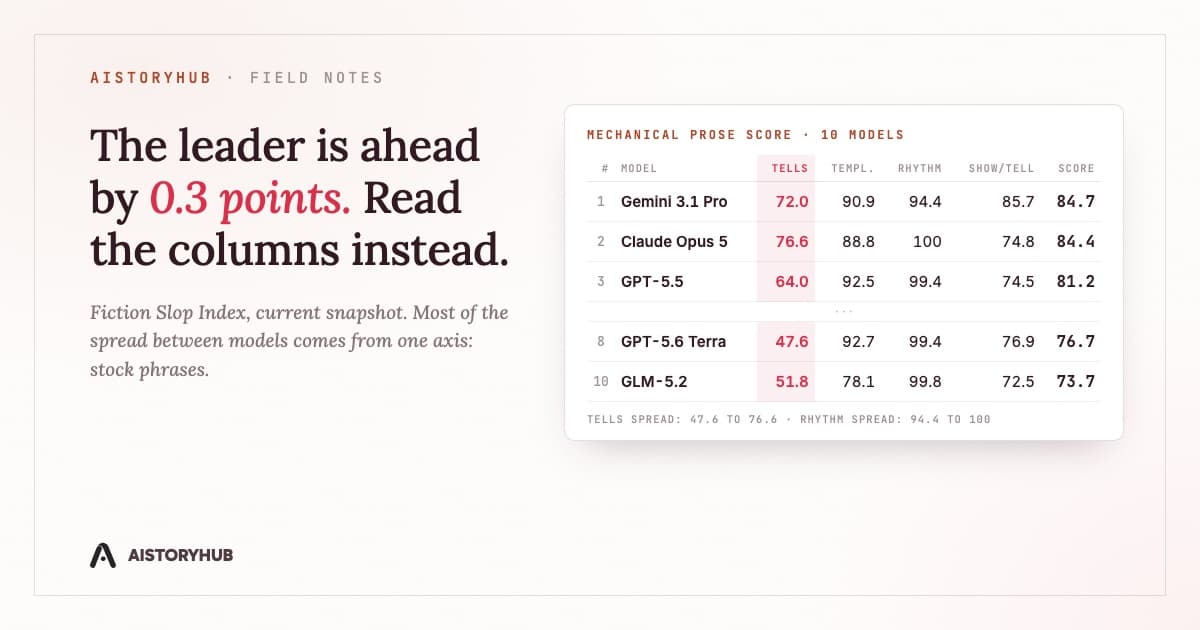
The short answer, as of the snapshot currently on the board: Gemini 3.1 Pro, by three tenths of a point. It scores 84.7 on the Fiction Slop Index. Claude Opus 5 scores 84.4. GLM-5.2 sits at the bottom with 73.7. Those numbers come straight from public/slop-index/leaderboard.json, the file the Slop Index page renders from, generated on July 25 and still the live snapshot as I write this.
The longer answer is that "which model wins" is the least useful thing on that page. I wrote the launch post in July, when the board had nine models and Gemini led by three and a half points. Since then Opus 5 joined the roster, the lead shrank to a rounding error, and the Arena started taking votes. So this post is less about the podium and more about how to read the four columns next to it, because that's where the part you can act on lives.
The board right now
Ten models from five labs. Each one writes to the same eighteen scenarios (six craft tasks across three genres, roughly 400 words each), two samples per scenario, default settings, nothing regenerated. Here's the full Mechanical Prose Score column, top to bottom:
- Gemini 3.1 Pro (Google): 84.7
- Claude Opus 5 (Anthropic): 84.4
- GPT-5.5 (OpenAI): 81.2
- GPT-5.6 Sol (OpenAI): 80.6
- GPT-5.6 Luna (OpenAI): 79.7
- Claude Sonnet 5 (Anthropic): 77.5
- Claude Fable 5 (Anthropic): 76.9
- GPT-5.6 Terra (OpenAI): 76.7
- DeepSeek V4 Pro (DeepSeek): 76.4
- GLM-5.2 (Z.ai): 73.7
Sample counts aren't identical. Most models have 36 scored passages. Opus 5 has 54, Fable 5 has 37, and DeepSeek V4 Pro and GLM-5.2 have 33 each, because both occasionally return an empty second sample. Kimi K3, which we dropped in July after it returned empty completions on seventeen of eighteen scenarios, isn't listed at all anymore.
Where the spread actually comes from
The headline score blends four axes. Tells is density against the 758-entry AI Cliché Corpus. Templating catches repeated openers, negation pivots, and symbolic final lines. Rhythm measures sentence-length variation. Show/Tell counts filter verbs and named emotions. With the Arena not yet in the score, Tells carries about 31% of the weight and the other three about 23% each.
Look at how far apart the models land on each axis, best to worst:
- Tells: 76.6 (Opus 5) down to 47.6 (GPT-5.6 Terra), a 29-point spread.
- Templating: 98.3 (GPT-5.6 Sol) down to 78.1 (GLM-5.2), about 20 points.
- Show/Tell: 85.7 (Gemini 3.1 Pro) down to 70.5 (Sonnet 5), about 15 points.
- Rhythm: 100 (Opus 5) down to 94.4 (Gemini 3.1 Pro), under 6 points.
Multiply each spread by its weight and the Tells column alone accounts for roughly nine points of possible separation. Templating accounts for under five, and Show/Tell and Rhythm together for about the same. In plain terms: on this board, the models differ mostly in how often they reach for stock phrases, and much less in how they build sentences.
Rhythm barely matters yet. Every model sits between 94 and 100, which tells you that at 400 words none of them produce the flat, metronomic cadence the axis is built to catch. I said in the rhythm post that it's the axis I trust least, and the current numbers back that up. It's real measurement on passages too short to separate anyone. Gemini 3.1 Pro has the lowest rhythm score on the board and still ranks first.
Profiles, not ranks
The more useful read is what each model gets wrong, because that tells you what your revision pass will be spending its time on.
Opus 5 has the cleanest vocabulary on the board (Tells 76.6) and a perfect 100 on rhythm, but a middling 74.8 on Show/Tell. Expect fewer stock phrases, and more "she felt" than the vocabulary score would lead you to guess.
Gemini 3.1 Pro is the reverse. Best Show/Tell score by a wide margin at 85.7, but Tells at 72. It leans on filter verbs and named emotions less than anything else tested, and then reaches for a familiar phrase anyway.
GPT-5.6 Sol has the best Templating score of any model, 98.3, meaning it almost never repeats a sentence opener or closes on a mirrored image. Its Tells score is 57.1. Structurally clean, lexically busy.
GPT-5.6 Terra is the strangest row. Worst Tells score on the board (47.6), yet second-best on Show/Tell (76.9). If you've ever had a model write a scene that was well staged and still full of stock phrases, this is what it looks like as numbers.
This matters more than the rank because the two failure types cost very different amounts to fix. A stock phrase is a find-and-replace problem. You see "the air was thick with," you cut it, you move on. A model that tells instead of shows, or ends every scene on an echo of its first line, gives you a structural problem, and structural problems take rewriting. I'd take a model with a weak Tells score and strong Show/Tell over the opposite, every time, because I can fix the first kind on a Sunday afternoon.
Price is a column the board doesn't show
The top two are separated by 0.3 points. In AIStoryHub's model catalog (lib/ai/model-catalog.ts), Gemini 3.1 Pro is listed at $1.25 per million input tokens and $10 per million output. Claude Opus 5 is listed at $15 and $75. Provider prices change without much warning, so check your own console before trusting either figure, but at those listed rates you'd be paying several times more per chapter for a difference this board can't distinguish from noise. The BYOK cost post has the arithmetic for what a full novel runs.
The free built-in model on AIStoryHub, DeepSeek V4 Flash, isn't on the board. Its sibling DeepSeek V4 Pro is, at 76.4, and I wouldn't assume the Flash version beats that.
What changed: the Arena is taking votes
In July the Arena was a plan. It's now live at /slop-index/arena: two passages written to the same prompt, model names hidden, and you pick the one that reads more human. There's a four-second minimum before your vote counts and a daily cap per visitor, and the methodology describes human-written control passages mixed into the pairs. After you vote, the page reveals which model wrote each side.
The votes aren't in the headline number yet. The page says so plainly: the Arena becomes 35% of the full Human Prose Score once there's enough vote volume to trust. Until then, everything above is the four mechanical axes, all pure functions of the text, which means you can rerun the arithmetic yourself from the methodology page and get the same answer.
What I'd do with this
If you're picking a drafting model, look at the axis your own revision habits are worst at catching and pick the model that's strongest there. If you hate cleaning up clichés, the Tells column is your ranking. If you're good at cutting phrases but struggle to rebuild a scene that states its feelings, sort by Show/Tell instead. And remember the line from the page itself: slop-free and good are different claims. A model can score 84 here and still write a dull chapter.
The Tells axis runs unmodified in the free Slop Checker, so you can score a passage from whatever model you already use against the same corpus. If you have five minutes, the Arena is where your judgment goes into the next version of the board.