

world building · ai writing
Book Three Shouldn't Have to Relearn Book One's Canon
JP LeBlanc · October 11, 2026 · 5 min read
Book three of a trilogy has a problem book one never had. It has to remember a hundred small decisions book one already made, decisions nobody wrote down anywhere an AI can see: the character's real name versus the alias everyone in the story calls her, the fact that the family estate burned down in chapter nine, which two characters are already dead and need to stay that way. Open a new document for the next book and, as far as the model is concerned, none of that happened. You're back to re-explaining a world you finished building months ago.
We shipped Universes to close that gap, and it's been live long enough now that I can describe what it actually does instead of what I hoped it would do when we started.
A Universe is a world your stories fork from, not a folder next to them
A Universe has an owner, optional curators you invite by email to co-write it, and a set of world entries. Every entry is one of eight types: character, species, location, faction, item, lore, timeline, or note. That list isn't arbitrary. It's the exact same eight types your own story's World tab already uses, because a Universe isn't a wiki that lives beside your books. It's built to become one.
You can build a Universe by hand, entry by entry, the same editing panel you'd use inside a story. Or write a README for it in plain language and let generation draft the description from a short instruction, the way you'd ask for a first pass at anything else. Set it to private if it's just scaffolding for your own series, or public if you want it findable and readable by anyone.
Forking is the part that actually solves book three
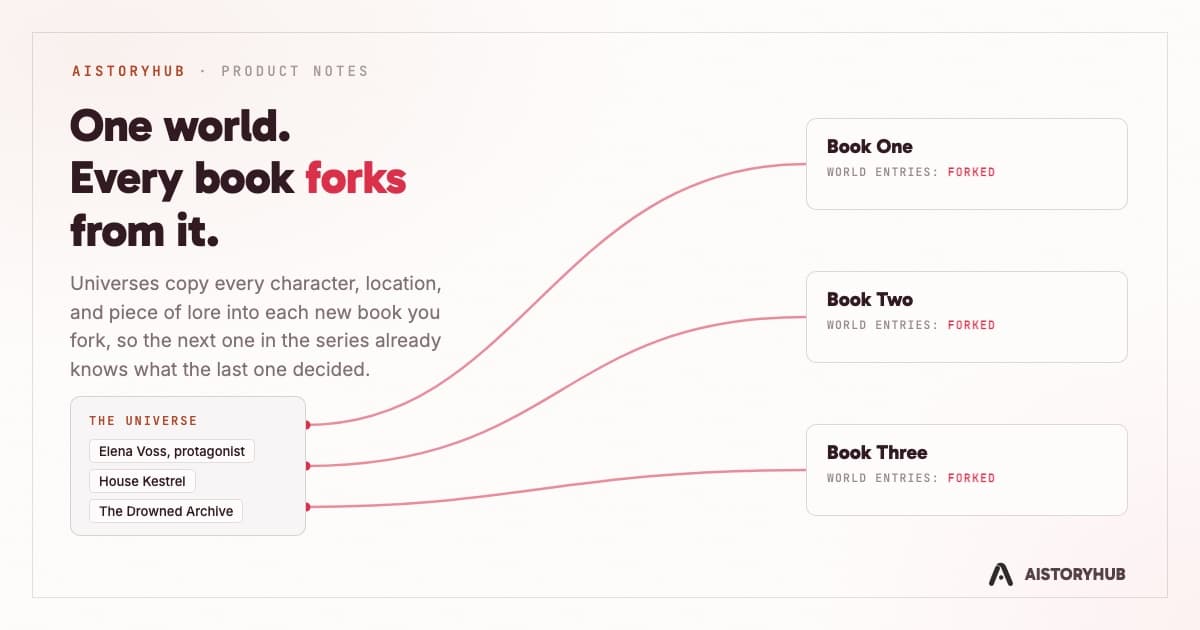
Every Universe page has a Fork button, the same fork-a-repository idea, and clicking it does one very specific thing: it creates a new story and copies every one of that Universe's world entries into it as that story's own characters, locations, factions, species, items, lore, and timeline. Not links back to the Universe. Actual copies, sitting in your new book's World tab from the moment it exists.
That copy is what makes book three stop starting from zero. Whenever you or Ash generate a chapter, the story's World tab feeds directly into the prompt: character profiles, dialogue style, speech patterns, and the surrounding cast of locations and lore, assembled automatically every time, not something you paste in. For most series-sized worlds, under about eighteen entries, every single one loads in full. Past that, the system gets more selective: it ranks entries against what the chapter you're actually writing is about and gives the rest a names-only mention instead of dropping them, so a sprawling world degrades gracefully rather than silently losing a character. Fork that same Universe again for book two, and it starts with the identical cast, the identical map, the same characters staying dead, without you typing any of it twice.
The fork itself runs through one function, used both when you click the button and when someone claims a draft they wrote anonymously before signing up. We built it that way on purpose, after noticing that two separate implementations of "here's what forking means" tend to drift apart quietly, and the drift shows up months later as a book whose world entries don't quite match the one it was supposedly forked from.
What forking doesn't do
Here's the caveat I want on the record rather than discovered the hard way. Forking copies your world entries as they stand at that exact moment. It is not a live link back to the Universe. Add a new location to the Universe after book one already exists, and book one's copy has no idea it's there unless you add it to book one directly too.
For a writer working through a trilogy front to back, this rarely bites. You build the world, fork book one, write it, and if something new comes up mid-book you add it to that book the same way you always would have. Where it matters is if you expand the shared world later and forget that the books forked earlier are now sitting behind it, unaware.
If you're co-writing the series, there's a review step built for exactly this. Curators can propose an addition, an edit, or a deletion to the Universe's canon, and the owner or another curator approves or rejects it, the way you'd review a pull request. An approved proposal lands in the Universe itself, not automatically in any book already forked from it. The discipline that used to live in a shared document now lives in that queue instead: canon changes get one specific place they're decided, before they ever show up in somebody's manuscript.
What a reader sees when the world is public
Make a Universe public and it gets a page anyone can land on without an account, browsable from the Universes directory by genre or by search. That page lays out the world entries the same way your own World tab does, characters, locations, organizations, items, lore, species, and timeline, up to a hundred and twenty of them. Below that sits every published story forked from that world, newest first, plus a running count of how many stories have been forked from it in total, published or not. For a series that has grown past one writer, or one you're happy to let readers explore or set side stories in, that page is the front door, and it exists whether or not you ever open the composer tools built for the platform's own public-domain worlds.
Setting one up
Start from the Universes directory and create one: a name, an optional description and genre, tags if you want it filterable, and a visibility setting you can change later. Add your characters, locations, and lore by hand, or generate a first-pass README and edit it down. If someone else is writing this series with you, invite them as a curator by email before you fork anything, so the canon review queue is already in place once there's canon worth reviewing.
Then fork it for book one. You're writing in an ordinary story from that point forward, the manuscript editor doesn't know or care that it started as a fork. When book two is due, don't duplicate book one's World tab by hand or copy-paste your notes into a new document. Go back to the Universe and fork it again. Book two opens already knowing the cast, the map, and which two characters are dead.
None of this writes book three for you. It just means the AI opens book three already knowing what book one spent three hundred pages deciding.