

byok · pricing · guide
You Bring the Key. Here's What a Novel Actually Costs.
JP LeBlanc · October 3, 2026 · 6 min read
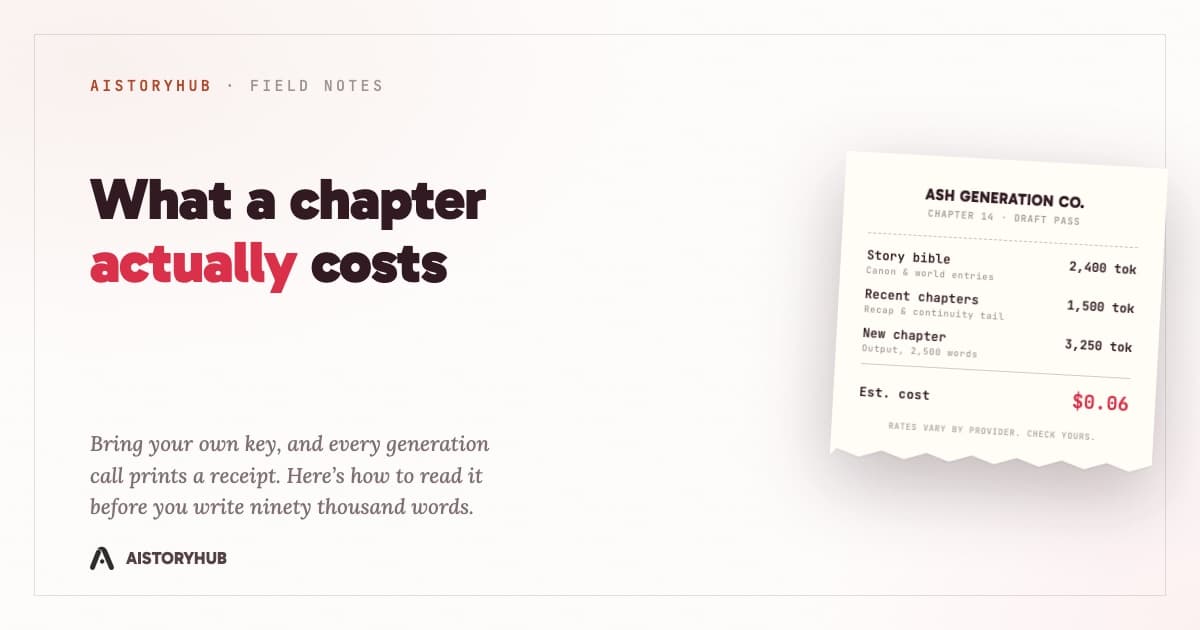
Every time Ash drafts a chapter for you, something like a receipt gets cut in the background: this many tokens in, this many out, this many cents at your provider's rates. You never see the line item unless you go digging, on your usage page or in your own provider's console. Go look, at least once. Most writers guess wrong about what actually costs money in an AI-generated novel.
I did too, the first time I sat down and ran the math instead of eyeballing an invoice.
Get a key
You need three things before AIStoryHub can write with your own model: an account with a provider, whatever billing that provider asks for, and about two minutes.
Anthropic is the simplest of the three. Sign in at console.anthropic.com, open API Keys in the left sidebar, click Create Key, name it, copy it immediately. Anthropic shows you the full key exactly once, so paste it somewhere before you navigate away.
OpenAI has one extra step first. Sign in at platform.openai.com and add a payment method under Billing before you do anything else. The API won't respond without one, not even for a single test call. Then open API keys, create a secret key, and copy it.
Google is the outlier in a good way. Sign in with a Google account at aistudio.google.com/app/apikey, pick or create a project, click Create API key, copy it. AI Studio's free tier means you can usually get a working key without adding billing at all, which is why it's where a lot of people start.
Add it to Settings
The page is Settings › API Keys. Each provider gets its own card: a status dot for whether the key is configured and valid, the last four characters of the key so you can tell yours apart at a glance, and an Add Key button that opens a short guided dialog with the same steps above, in case you'd rather not leave the tab to go find them.
Once you save a key, we encrypt it at rest with AES-256-GCM and only decrypt it in memory for the length of the request that needs it. The database holds an encrypted blob and a four-character hint, nothing else, and the key is never logged. Delete it and that's the whole history of it, gone.
What model you're actually pointing at
Each provider offers more than one model, and the settings page groups them by rough cost, speed, and quality so the choice isn't blind.
- Anthropic runs Claude Opus 5 and Claude Opus 4.8 at the top for quality, Claude Sonnet 5 and Claude Fable 5 doing most of the actual fiction generation, and Claude Haiku 4.5 for fast, cheap jobs like a continuity check.
- OpenAI offers GPT-5.6 Sol as the current flagship, GPT-4o and o3 a step down (o3 trades speed for more reasoning), and o4-mini or GPT-4o mini for when price and speed matter more than headline quality.
- Google runs Gemini 3.1 Pro (Preview) and Gemini Pro (Latest) at the top, Gemini 2.5 Pro just under those, then three Flash variants, 3.6, 3.5, and 3.5 Lite, scaling down from there for speed and price.
You can assign a different model to a different job. Drafting a chapter doesn't have to use the same model as a style pass or a continuity check. That split changes your bill more than which single model you pick.
If you don't want to add a key yet
Sign up and you can write immediately on AIStoryHub's own model, currently DeepSeek V4 Flash, funded by us through OpenRouter. No card, no key, nothing to configure, and it's a one-click toggle in the same Settings page. The honest caveat is right there in the product too: quality and the underlying model aren't guaranteed and can change without notice. Treat it as a way to find out whether you like writing in the tool before you decide anything costs money at all.
What a novel actually costs
Here's the part most people skip: the only piece of this that determines what you actually pay.
A rough, useful rule: English prose runs about 1.3 tokens per word. A 500-word scene comes out to roughly 650 tokens of output. That part is intuitive. What's less intuitive is that the words coming out aren't the expensive part of an AI-generated novel. The words going in are.
I assumed the opposite when we first built the generation pipeline. Output felt like the "real" cost, since it's the actual prose you're paying for. It isn't, not once a story has any length to it. Every generation call sends fresh context: relevant entries from your story bible, a recap of what's happened, the tail end of the previous scene so the new one doesn't open mid-gesture. All of it gets trimmed to fit a context budget rather than growing forever. That trimming logic took a few passes to get right on our end; an early version let the story bible section grow unchecked, and a long-running serial would eventually have shoved everything else out of the window. Even trimmed, the context is real weight, and you pay for it again on every call, every chapter, for the life of the manuscript. Output is capped by how long a chapter is. Input keeps compounding.
Run the arithmetic on an actual book. Call it 90,000 words, split into 36 chapters of 2,500 words apiece. By the back half of that manuscript, a single generation call is commonly sending something in the neighborhood of 3,000 words of context: canon, recap, continuity tail. That's about 3,900 input tokens, plus roughly 3,250 output tokens for the new chapter (2,500 words at 1.3 tokens each).
Now price it, with numbers I'm labeling as exactly that, placeholders: say $3 per million input tokens and $15 per million output tokens, in the range our own model comparison shows for a mid-tier model as of this writing. Don't take those two numbers as current fact. Providers change pricing without much warning, and by the time you read this they may already be wrong. Check your provider's actual pricing page before you trust any number, including mine.
With those placeholders, one chapter runs about six cents. Thirty-six chapters, first draft only, comes to a bit over two dollars. Add a revision pass and a Human Grit Pass on top of that (each is its own call, with its own context), and a fully drafted, fully revised 90,000-word novel tends to land in the low single digits of dollars, not the tens. That's roughly consistent with the worked examples on our own pricing page, though I built this one from scratch rather than quoting theirs back to you.
Set a limit before you start
One tip, and it costs nothing: before you paste a key into anything, go into that provider's own console and set a spending limit. Anthropic, OpenAI, and Google Cloud all have one, usually under Billing or Usage. It won't stop you from writing. It will stop a runaway retry loop or a script you forgot was still running from turning into a bill you notice a month later instead of the day it happened.
The free model doesn't carry that risk to your wallet, since we're the ones paying OpenRouter for it. Your own key is the one place where five minutes in a settings page is worth it.
Add the key. Write the chapter. Go look at what it actually cost. That's the whole exercise, and it usually costs less than you assumed walking in.