Blog · byok · ai models · ai writing
One Model Per Job: Drafting, Revising, and Brainstorming With Different AIs
JP LeBlanc · · 5 min read
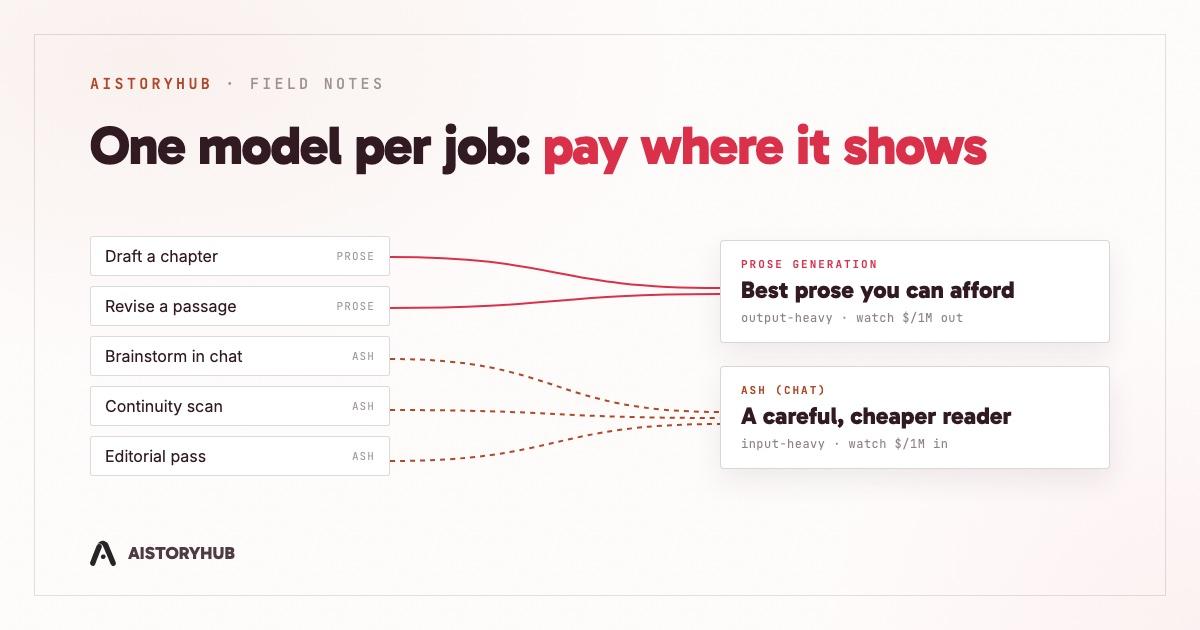
Most people who add an API key to AIStoryHub pick one model and use it for everything. I did the same for a while. It's the obvious move, and for most books it leaves either money or quality on the table, because the two kinds of work the app asks a model to do pull in different directions. One writes prose for your book. The other reads your book and talks to you about it. Those jobs reward different strengths, and they cost money in different ways.
Two slots, and what each one powers
Under Settings › API Keys, alongside your provider keys, there are two model pickers. One is labeled Ash (Chat), "the conversational assistant inside your stories." The other is Prose Generation, "the model used to write and expand your story content." Each one gets its own provider and its own model.
Here's what actually routes through each, from the code rather than the labels:
- Prose Generation handles drafting chapters, improving or iterating on a passage, structural revisions, generating characters and story elements, chapter outlines, dialogue styles, and the Style Lab's analysis of pasted writing samples.
- Ash (Chat) handles the story chat, the Editorial Pass, the whole-book continuity scan, writing suggestions, and the structural critic that checks freshly generated prose for structural tells before it gets redrafted.
So "drafting, revising, brainstorming" maps onto two slots, not three. Drafting and revising live on the prose model. Brainstorming, critique, and continuity live on the Ash model. If you leave a slot unset, the app falls back to the first valid key you have, in the order Anthropic, OpenAI, OpenRouter, Gemini, on that provider's default model.
The prose slot: pay for the words
Prose generation is the job where the model's own habits end up in your book. Every tic it has, every stock phrase, every sentence built to the same length, lands on the page. This is the slot where quality is worth paying for.
We publish one way to compare models on exactly this: the Fiction Slop Index. The current leaderboard file (generated July 25, 2026, 33 to 54 sample passages per model) ranks models on a Mechanical Prose Score built from four measured axes: AI tells, templating, rhythm, and show-versus-tell. The fifth axis, a blind human Arena vote, is still pending, so treat this as a measure of mechanical habits rather than of taste. The top of the board, higher is cleaner:
- Gemini 3.1 Pro: 84.7
- Claude Opus 5: 84.4
- GPT-5.5: 81.2
- GPT-5.6 Sol: 80.6
- Claude Sonnet 5: 77.5
- Claude Fable 5: 76.9
Now put those next to the prices in our settings catalog, which are display approximations you should check against each provider's own pricing page. Gemini 3.1 Pro is listed at $1.25 per million input tokens and $10 per million output. Claude Opus 5 is listed at $15 and $75. On this index the two sit 0.3 points apart, and Opus output costs seven and a half times as much per token.
That doesn't make Opus a bad choice. The axes disagree with each other in useful ways: Opus 5 has the best tells score on the board and a perfect rhythm score, while Gemini 3.1 Pro leads on show-versus-tell. If one of those is exactly your problem, it can be worth paying for. And none of it tells you whether you'll like the voice. What it does tell you is that the most expensive option isn't automatically the cleanest prose, and a mid-priced model is close behind.
Prose generation is output-heavy, so the output price is the one to watch for this slot. The settings page shows each model with a cost tier ($, $$, or $$$) weighted mostly toward output for exactly that reason, plus speed and quality badges. For a worked example of what a full novel costs to draft, see what a novel actually costs.
The Ash slot: pay for the reading
Ash's cost works the other way around. Every chat message rebuilds a briefing of your whole project: the story overview, the story bible, every chapter (each capped at 10,000 characters), and the file you have open. That briefing goes to the model on every turn. Ash's replies are short by design. So almost all of an Ash bill is input.
Rough arithmetic for a book in progress: thirty chapters near that 10,000-character cap is about 300,000 characters, or something like 65,000 tokens, before the story bible. Using the same catalog prices as placeholders, that's roughly 20 cents a message on Claude Sonnet 5 ($3 per million input), about a dollar on Opus 5, around 6 cents on Claude Haiku 4.5, and around a cent on Gemini 3.5 Flash. A message where Ash calls tools can mean several model calls in one turn, so the real figure varies. You don't have to guess, though: once you've sent a few messages, the chat panel shows a typical per-message cost based on your own recent history.
The Ash slot also needs different strengths. It wants a model that reads a long briefing without losing track of who did what in chapter 6, and that follows Ash's instructions about when to propose an edit and when to just talk, which mostly comes down to reliable tool calling. None of that shows up in a prose-quality ranking. A model that writes slightly flatter sentences can be an excellent reader and a good critic, and for chat the sentences mostly stay in the chat.
Context window matters here too. The briefing is allowed to grow very large before files start getting dropped, so a model with a small context window will hit its limit on a long book sooner than you'd expect. The flagship and mid-tier models from all three direct providers handle long input; check the specifics for anything small or older.
Pairings that make sense
I don't have data that ranks pairings against each other, so treat these as defaults to adjust:
- Quality where it shows, economy where it doesn't. A top-of-index model on Prose Generation, a fast, cheap model on Ash. You get clean drafts, and long chat sessions stay cheap. The trade-off is that critique from a smaller model is shallower, so step up the Ash model for a serious editorial session and step it back down afterward.
- One provider, two tiers. If you only want one key, use the provider's best model for prose and its cheaper one for chat. Anthropic, OpenAI, and Google all offer both ends.
- Free while you find out. Either slot can use AIStoryHub's own free models, funded by us through OpenRouter, quality not guaranteed. They follow the same split: currently DeepSeek V4.1 Flash on the Ash slot and GLM-5.3 on the prose slot. Putting Ash on the free model and your key on prose is a reasonable way to keep costs near the price of drafting alone.
Test it on your own book
The index tells you how a model behaves on average across our test prompts. Your story is a different prompt. The cheapest way to check is to keep the test inside your project: create two sandbox chapters with the same outline, generate the first with one prose model, switch the Prose Generation slot, and generate the second. Sandbox chapters see your canon but don't feed later chapters, so nothing about the losing draft leaks into the book. Read both, keep the one that sounds like the book you're writing, and set the slot accordingly.
Both pickers are in Settings › API Keys. Changing either takes effect on your next request, and you can switch back anytime.