

craft · ai writing
50,000 Words in November With AI, Without Losing Your Voice
JP LeBlanc · November 2, 2026 · 5 min read
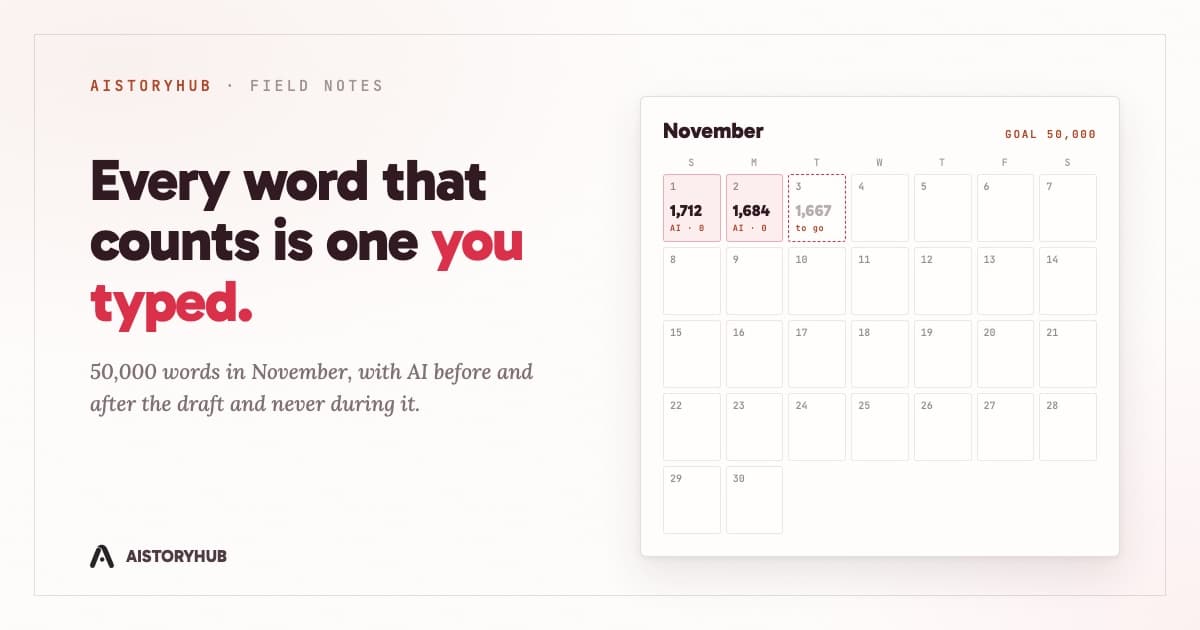
It's November 2nd. If you're writing fifty thousand words this month, you're around 3,300 words in, or you're about to be. The daily number is 1,667, and any model you can connect to AIStoryHub will produce 1,667 words in less time than it takes to make coffee. That fact sits over every November novel attempt now, and it's better to decide what you'll do about it today than at 11pm on the ninth, four thousand words behind.
Here's the uncomfortable detail. The word goal on a story's home page in AIStoryHub (there's a 50,000 preset sitting between Novella and Novel) counts the words in your manuscript. It has no idea who wrote them. A chapter you typed and a chapter Ash generated fill the same progress bar. So the counter won't keep you honest. That job belongs to a rule you set in advance.
Pick the rule first
Mine is simple: the words that count toward the fifty thousand are words I typed. AI can do almost anything around those words. It can't be those words.
You might pick a looser rule. Some writers are fine letting a model draft a connective scene they plan to rewrite in December, and that's a legitimate way to work. It's your book. What doesn't work is having no rule at all, because then the decision gets made one tired evening at a time, and tired evenings always vote for the generate button.
Why drift compounds in a long draft
There's a mechanical reason to be stricter than you might think. When AIStoryHub generates a chapter, it bases the voice partly on the last two paragraphs of the nearest preceding canon chapter. That's deliberate: the chapter right before this one is the best sample of how the book sounds right now. It also means that if chapter 11 is model prose you lightly edited, chapter 12's generation takes its tonal cue from the model's sentences instead of yours. Let that happen three or four times and the back half of the draft is imitating itself.
Something similar happens to the writer, more slowly. Spend a month reading generated scenes inside your own manuscript and their rhythms start showing up in your typing, the way you pick up an accent from a roommate. The fix for both problems is the same. Keep the canon chapters yours.
A daily loop that keeps the words yours
This is the loop I'd run. The AI shows up before and after the draft, never during.
- Before (ten minutes). Reread your last page. If you've lost the thread, ask Ash where things stand: who knows what, which promise from chapter four hasn't paid off yet. Ash has your manuscript and story bible in front of it, which makes it good at exactly this kind of recall. Ask it for five possible next beats if you like, then close the chat and choose one in your head. Don't paste its phrasing into the document, even as a placeholder. Placeholders turn into prose by the third week.
- The draft (as long as it takes). Chat closed. Write the 1,667 badly. When you'd normally stop to look something up, leave a bracket instead: [NAME OF THE INN], [CHECK: was it March?]. The bracket costs two seconds. Stopping to ask a model costs you the paragraph you were in.
- After (fifteen minutes, every few days). Now the AI is a reader. Run the continuity check, which reads your canon chapters together and flags passages that can't both be true, plus softer slips worth a second look. Paste a page into the Slop Checker; tired humans write stock phrases too, and November is when everyone is tired. Then go back and fill in the brackets.
When you're stuck, generate the wrong version
The most useful AI move I know for November puts zero generated words into the book. When a scene won't come, add a sandbox chapter and let the model draft the scene there. Sandbox chapters sit in their own group in the file browser, they don't add to the manuscript word count, and they're left out of the context later chapters are generated from. The mechanics are in Canon vs. Sandbox.
Read the generated version once. Usually it's wrong in a way that tells you what the scene is about. The characters hug when they should have fought. The betrayal gets explained out loud when it should have stayed under the table. Your reaction (she would never say that) is the scene you were missing. Close the sandbox, open the canon chapter, and write the version you just argued for. Don't paste from the sandbox, and don't keep it open in a split view while you type.
The second week
Week two is the classic place to stall. The opening energy is spent and the middle hasn't arrived. It's also when the generate button looks its best. If you're behind, there are better options than handing over a chapter:
- Lower the daily target for three days instead of dropping the rule. A thousand words you wrote beats 1,667 you didn't.
- Write the next scene as dialogue only: no tags, no description. It goes fast, it's yours, and you can dress it in December.
- Skip ahead to a scene you're excited about. A November draft doesn't have to be written in order.
- Use the sandbox trick above, then write your own version cold.
Give it your voice before you need it
If AI is going to generate anything in this book, even sandbox throwaways, give it your voice early. Style Lab builds a Voiceprint by analyzing a sample of your writing (1,500 words minimum, 2,000 to 10,000 recommended), and you can pin that profile to the story from the Voice Profile selector on its home page. Use something you wrote before this month: last year's draft, a few short stories. A sandbox scene written in a rough approximation of your voice makes a better wrong version than one in the model's house style, because the places where it misses you are more specific. What a Voiceprint actually measures covers the dials.
What it costs
Less than you'd expect, because reading is cheaper than writing. AIStoryHub is free. New accounts can use a free built-in model with no key, or connect an Anthropic, OpenAI, Google Gemini, or OpenRouter key and pay that provider directly for what they use. The continuity check and Ash conversations run on your connected model. The Slop Checker makes no model call at all; it matches your text against our cliche corpus in the browser. If you do let a model write chapters, here's what a novel actually costs on your own key.
December
The draft you have on December 1st will be rough, and it should be. Revision can fix clumsy sentences. It has a much harder time finding a voice that was never on the page.
Tonight, before you write: open the story, set the word goal (the 50,000 preset is there), and put your rule in the story's notes field where you'll see it every evening.