

craft · horror · ai writing
Horror Is Where AI Prose Fails Hardest
JP LeBlanc · October 31, 2026 · 5 min read
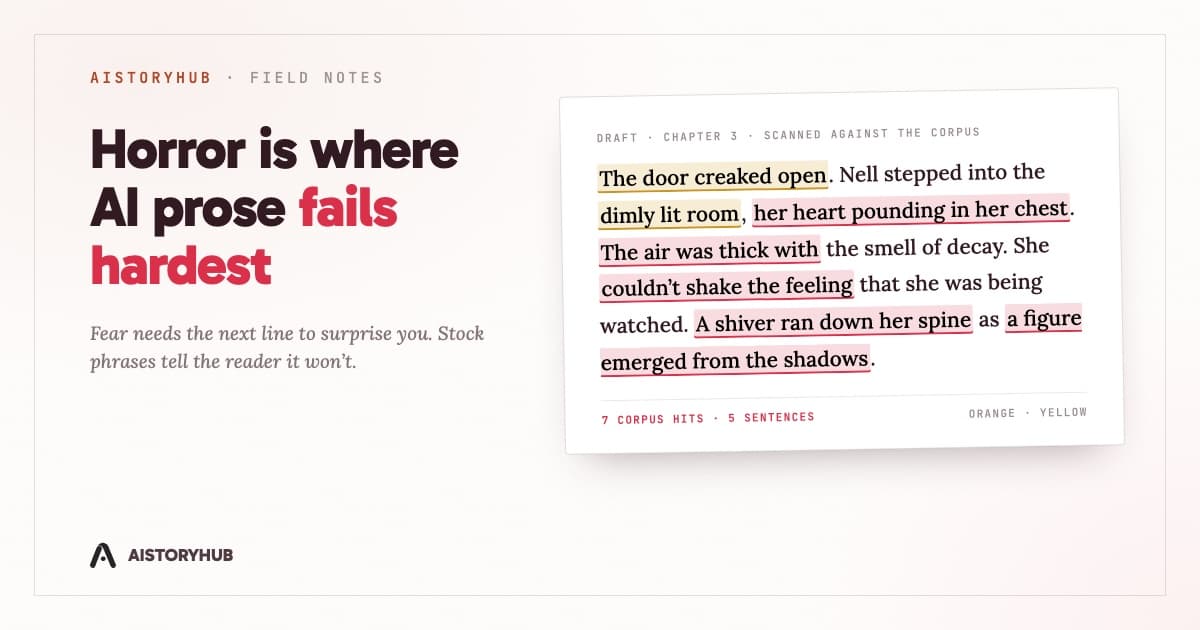
Ask any model for a scary scene and you'll get something like this. I wrote it to sound like the average of a dozen drafts, but you've read it before:
The door creaked open. Nell stepped into the dimly lit room, her heart pounding in her chest. The air was thick with the smell of decay. She couldn't shake the feeling that she was being watched. A shiver ran down her spine as a figure emerged from the shadows.
Five sentences, and every one of them contains at least one entry from our AI Cliché Corpus: "the door creaked open," "dimly lit room," "heart pounding in her chest," "the air was thick with," "couldn't shake the feeling," "a shiver ran down her spine," "a figure emerged from the shadows." All seven came into the corpus from the EQ-Bench slop-score trigram list (Paech, 2025), a published list of phrases that turn up far more often in model-written fiction than in human writing. None of them is rare in fiction generally. All of them together, in one paragraph, is what a model writes when you ask for fear.
It's Halloween, so I want to make a specific argument: horror is the genre where this matters most, and it isn't close.
Horror runs on the next word being wrong
A language model writes by predicting the most likely continuation. For most prose, likely is fine. A romance can survive a predictable sentence because the reader is there for the people. A thriller can survive one because the plot carries it.
Horror can't, because the whole mechanism of fear on the page is a gap between what the reader expects and what arrives. Dread is the reader predicting something bad and not being able to name it. A scare is the prediction failing at the right moment. Prose built from the most probable phrase is, almost by definition, prose with no gap in it. The reader saw "a figure emerged from the shadows" coming from the moment the door creaked.
That's why a stock phrase in a horror scene does more harm than the same phrase in a love scene. Besides reading as generic, it tells the reader the writer isn't going to surprise them, and fear needs the reader to believe you might.
What models get backwards
They report the fear instead of causing it. Look at the sample again. Nell's heart pounds and a shiver runs down her spine. Every frightening thing in that paragraph happens to Nell's body, and none of it happens to the reader. Our Fiction Slop Index has a whole axis for this, Show/Tell, which counts filter verbs and flat labels like "was terrified." In horror, every one of those is a missed scare. If the reader is frightened, you don't need to tell them Nell is. If they aren't, telling them won't help.
They describe the wrong things. "Decay," "shadows," and "dim light" are the props of horror, and props are exactly what the reader has already furnished the room with. Real dread usually comes from an ordinary detail that's slightly off: the dog's water bowl is full but the dog has been dead for a year; someone has set the table for four and there are three of you. The specificity is doing the work. A model reaching for "the smell of decay" is choosing the most horror-flavored word available, and the most horror-flavored word is the one the reader has the strongest defenses against.
They explain. Ask a model to continue past the figure in the shadows and within a page you'll usually learn what it is and what it wants. Models resolve uncertainty because unresolved threads look like mistakes to them. In horror, the unresolved thread is the product. The monster you've described in full is a monster the reader can now size up and stop fearing.
The same scene, revised
Here's the paragraph again, rewritten by hand with those three things in mind:
Nell found the light switch on the second try. Nothing in the room had moved since the funeral except the chair by the window, which was facing the wall now, the way her mother used to sit when she didn't want to be talked to. Nell didn't turn it around. She went to get the boxes from the car, and when she came back she didn't look at the chair at all, which took more effort than she expected.
No creak, no shadow, no shiver. Nell's fear is never named. It's in the one action she doesn't take, then in the second one she avoids. The specific detail (a chair facing the wall) is ordinary, and the meaning attached to it (the dead mother's habit) is what makes it wrong. And nothing is explained. The reader doesn't know whether the chair moved on its own, or a cousin moved it, or Nell is misremembering. That uncertainty is the scene.
The revision has less atmosphere than the original, and that's usually the direction the fix goes.
Using a model for horror anyway
I wouldn't keep AI out of horror altogether. I'd stop asking it for the thing it's worst at, which is atmosphere on demand. Some approaches that work better:
- Bring the wrong detail yourself. Decide what's off in the room before you generate, and put it in the request. A model handed "the chair faces the wall, the way the dead mother sat" writes a far better scene than one handed "make it creepy."
- Ask for the mundane, then pick. Have the model list twenty ordinary objects in a specific setting, a laundromat at closing or a dentist's waiting room. Choose the one that would be most unsettling if it were slightly wrong. The model is good at inventory and bad at menace, so use it for inventory.
- Make withholding a rule. In AIStoryHub, Story Rules go into every generation prompt under an "always follow" heading. "Never describe the creature directly; only show its effects" is the kind of rule that keeps a model from explaining your monster in chapter four.
- Cut the body. In revision, search your draft for spine, breath, heart, and pulse. Most of what you find can go. Keep one, at the moment it matters most.
One more thing to check: the ending. Models like to close a scene with a line that tells you how to feel about it, the "little did she know" move, which the corpus also lists. Horror scenes are stronger when they stop one sentence early. End on the chair, not on Nell's thoughts about the chair.
Check your own scene
Paste your scariest scene into the Slop Checker and see what lights up. It matches against the same corpus I quoted at the top, so the stock horror phrases will show up by name, along with the rest of the word-level tells. It won't tell you whether the scene is frightening. That part still depends on finding the one detail in the room that shouldn't be there.