

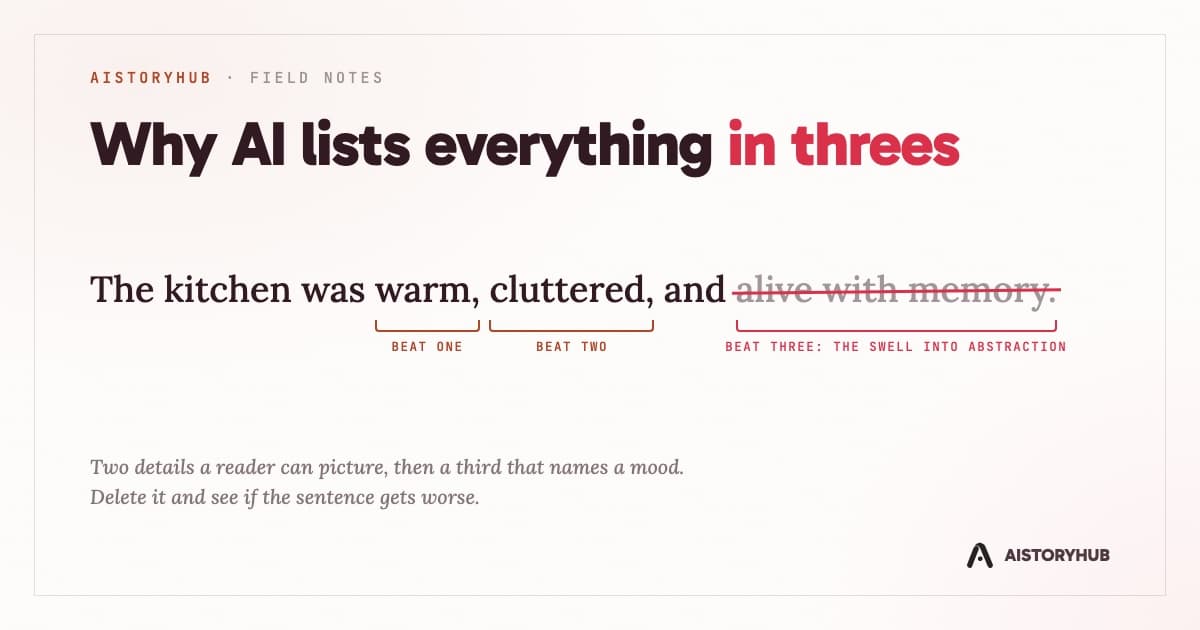
Here's the kind of sentence a model will hand you in almost any generated chapter: "The kitchen was warm, cluttered, and alive with the memory of every meal she'd ever cooked there." Nothing in it is wrong. Every word is spelled correctly and the grammar holds. But read twenty pages of a model's fiction and you start to hear it coming: two concrete adjectives, then a third item that swells into something abstract and lands the sentence like a door closing.
It's the triad, and once you notice it you'll find it everywhere in AI prose. Adjectives arrive in threes, and so do the short fragments that close a paragraph. Our AI Cliché Corpus carries it as an entry called "Rule of three / tricolon compulsion," orange tier, with the example "It's fast, reliable, and scalable." That example comes from marketing copy, but the habit shows up in fiction just as often, and in fiction it does more damage.
Why models do it
Three is the smallest number that feels like a pattern. Two items read as a pair, a comparison. Three items read as a set, complete and closed. Speechwriters have known this forever, and the training data is full of their work: sermons, commencement addresses, op-eds, product pages, every persuasive essay a student ever turned in. A model learning what "finished-sounding" English looks like learns that a list of three ends a thought with authority.
The problem is that the model learns the rhythm without the reason. A speechwriter uses a triad when there really are three things to say and the cadence helps the audience remember them. A model uses one because the slot is there. So the first two items do the work and the third is filler with good posture. In my experience it's almost always the third item that goes abstract: "warm, cluttered, and alive with memory," "tired, hungry, and utterly defeated," "the smell of coffee, the hum of the fridge, and the quiet sense that something had changed."
That last pattern is the fiction version, and it's worth looking at closely. Two sensory details a reader can actually picture, then a third that names a mood instead of showing one. The triad gives the model a place to sneak the telling in.
The shapes it takes
It isn't only adjectives. These are the forms I see most in generated fiction:
- Adjective stacks: "cold, gray, and unforgiving." The most common and the easiest to spot.
- Sensory inventories: a sight, a sound, then a feeling, strung together with commas as if the narrator were taking notes.
- Prepositional chains: "She said it to nobody, to the room, to the pale blue wireframe." This one is quoted from the prompt our own structural critic uses to describe the tell, because it reads as hardboiled pacing without anything hardboiled happening.
- Fragment payoffs: a paragraph that closes on "No warning. No mercy. No way back." The corpus rates that exact "No X. No Y. No Z." shape red, the highest tier.
- Verb sequences: "He turned, hesitated, and walked away." Sometimes this is just what happened. Often it's the model padding a single action into a beat.
Any one of these is a normal sentence. Human writers use triads constantly and well. The tell is frequency: when a page has six of them, and they all escalate the same way, the prose starts to sound like it was assembled from a kit.
A quick test you can run on your own draft
Search your chapter for ", and " and look at what precedes it. Every time you find a list of exactly three, try deleting the third item and reread the sentence.
If the sentence gets better, or at least doesn't get worse, the third item was rhythm filler. That happens more often than you'd think. "The kitchen was warm and cluttered" is a fine sentence that trusts the reader to supply the memories.
If the sentence breaks, check whether the items are the same grammatical shape and roughly the same length. Matching shapes are what make a triad sound mechanical. Three real things, written unevenly, usually sound fine.
How to revise one
There's no single fix, and that's the point. If every triad becomes the same replacement, you've just traded one pattern for another. Rotate through these:
Cut to the best one. Of "warm, cluttered, and alive with memory," pick whichever is most specific to this kitchen. Usually that means replacing all three with one concrete detail: "Every surface in the kitchen had something on it." One true observation beats three generic adjectives.
Cut to two. Pairs don't close the way triads do. "Cold and gray" leaves the sentence slightly open, which often reads as more natural.
Go past three, unevenly. A real list, the kind a person makes when they're actually looking at something, rarely stops at three and rarely has matching lengths. "The counter held a colander, two days of mail, a bowl of lemons going soft on one side, and her father's reading glasses, which she still hadn't moved." The fourth item does the emotional work, and it does it by being a fact.
Break the parallel. Keep the items but change the grammar of one. "The kitchen was warm. Cluttered too, the way it got when nobody had the heart to clear it." Same content, but the rhythm stops announcing itself.
Turn the list into a sequence. If the three items are actions, make them cause each other instead of sitting side by side. "He turned. Halfway to the door he stopped, and for a second she thought he'd come back."
Don't overcorrect
The failure on the other side is real. A writer who learns to fear triads can end up with nothing but pairs, or with long comma-spliced run-ons built specifically to avoid landing on three. We ran into this inside AIStoryHub's own pipeline. The full chapter generator runs a structural pass after drafting: a critic finds tells like repetition chains and in-sentence triads, and each flagged span gets rewritten from its intent with the old wording hidden. The redraft is only kept if it actually lowers the structural signal, and it's rejected if it newly trips the uniform-cadence check. The code comment describing that check calls out this exact failure: trading rule-of-three for comma-marathons. A fix that creates a new pattern isn't a fix.
Some triads should stay. If there are three suspects, list three suspects. If a character is the kind of person who talks in rehearsed rhetorical flourishes, let them, and let other characters notice. Deliberate rhythm in a climactic paragraph can earn its place, as long as it's the only one on the page.
What tools can and can't see
One honest limitation. The Slop Checker matches phrases, and a triad has no fixed phrase. It will flag "No X. No Y. No Z." because that shape has a dedicated pattern behind it, but a general list of three adjectives slides through, the same way burstiness did until we built a rhythm detector for it. For now, the comma search above is the most reliable check you have. It takes about ten minutes per chapter, and by the second chapter you'll start catching them while you type.