

voice fingerprint · tools · style
Voice Fingerprint: Paste Your Writing, See Your Style as Numbers
JP LeBlanc · October 29, 2026 · 4 min read
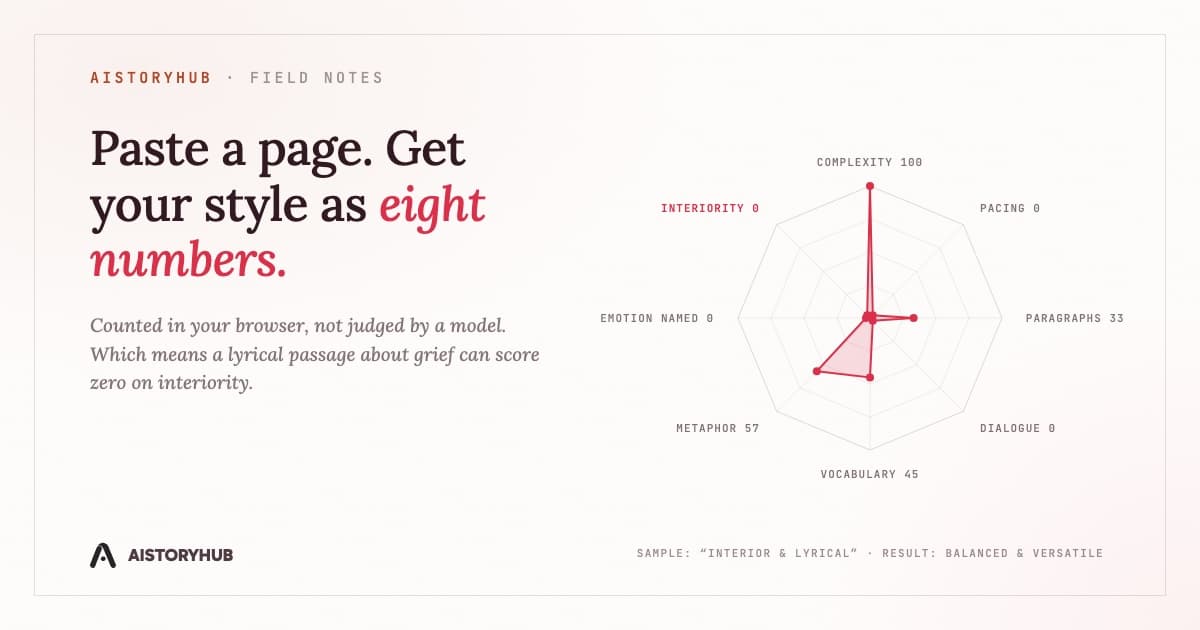
The Voice Fingerprint Analyzer is the smallest tool we have and probably the one people misread most. You paste at least 150 words of prose, press Analyze, and get back eight numbers, a sensory breakdown, and a two-word label like "Lean & Propulsive." It looks like a personality quiz. It's closer to a ruler.
I want to explain what each number is actually counting, show where it gets things wrong, and suggest a few ways to use it that are worth more than the label at the top.
What happens when you press Analyze
Nothing leaves your browser. There's no model involved and nothing is saved. The whole analysis is about 260 lines of code in lib/tools/voice-fingerprint-scan.ts that splits your text into sentences and paragraphs, counts some punctuation, and matches small hand-built word lists. Same input, same output, every time.
That's the point and the limit. It's fast and private and free, and it reads only what's on the surface. The FAQ on the page says so directly: it's a mechanical read, not a critical one.
The eight dials
Each dial is a 0 to 100 score between two labelled poles. Here's what drives each one:
- Sentence Complexity (simple, direct to complex, nested): average sentence length, commas per sentence, and how often you use subordinating words like which, because, although, while.
- Pacing (contemplative to kinetic): the inverse of sentence and paragraph length. Short sentences in short paragraphs read as fast.
- Paragraph Length (short, punchy to long, flowing): average words per paragraph.
- Dialogue Ratio (minimal to dialogue-heavy): the share of your characters that sit inside quotation marks.
- Vocabulary Register (plain to elevated): average word length and the share of words eight letters or longer.
- Metaphor Density (literal to figurative): how often comparison markers appear, such as like, as if, as though, seemed to.
- Emotional Directness (oblique, subtext to named outright): phrases that name a feeling, like "felt afraid" or "was furious."
- Interiority Access (external only to deep interior): thought verbs such as thought, wondered, realized, told herself, plus the common cues of free indirect style, such as had come to believe or found herself.
These eight share their names and scale with the thirty dials Style Lab uses for a full Voiceprint. They're the ones that can be read from surface text without a model. The other twenty-two need something that actually understands the prose, which is why they live in Style Lab and need at least 1,500 words. I covered that version in what a Voiceprint actually measures.
Below the dials, the sensory profile counts words tied to sight, sound, touch, and scent or taste, and shows each as a share of the total. It needs at least three sensory hits before it shows anything, so a passage of pure dialogue will come back with no profile at all.
The label at the top is picked from eight archetypes by checking simple rules in order: pacing above 65 with dialogue above 50 is "Kinetic & Talkative," vocabulary and complexity both above 62 is "Ornate & Literary," and so on. The first rule that matches wins. If none match, you get "Balanced & Versatile." The share link only carries the label, never your text.
What a word count can't see
Every dial is built from counts of specific words and punctuation. That makes it fast and repeatable, and it also means it measures the surface of the prose, not what the prose is doing. Two cases are worth knowing about before you trust a number.
Interiority is counted, not read. The dial picks up thought verbs and the usual signposts of free indirect style, but a passage can stay inside one character's head for a page without using any of them. The best interior prose often doesn't. A low score there isn't a verdict on your access to the character. It tells you how often the text signals the act of thinking.
Comparison words aren't always comparisons. The Metaphor Density dial counts markers like like and as if. It skips the verb ("I like the town"), but a marker is still only a marker. Read the dial as a rough signal of how often you reach for comparison, not a count of actual metaphors.
None of this makes the tool useless. It means a score is a statement about specific words and punctuation, and you should read it that way.
How I'd actually use it
The label is the least useful output. The dials are useful when you compare them, not when you read one result in isolation.
Compare your chapters to each other. Paste chapter 3 and chapter 14 separately. If Pacing dropped thirty points, that might be the story slowing down on purpose, or it might be you getting tired. Either way it's worth knowing.
Compare your prose to a model's. Write a scene yourself, then have a model draft the same scene from the same notes, and run both. The dials where they differ most are where the model is pulling your book away from you. In my experience Emotional Directness is a common one: models name feelings more than many writers do.
Check a revision did what you meant. If you set out to cut back on filtering ("she noticed," "he felt"), Emotional Directness and Interiority Access should both move. If they didn't, the revision changed less than you think.
Paste a range, not one scene. A dialogue-heavy scene and a descriptive one from the same book will produce very different fingerprints. If you want a picture of your voice overall, paste a mix, up to the 6,000-word counter on the page.
Where it leads
If the eight dials look about right and you want a version that actually feeds your generations, that's Style Lab: a full AI read across thirty dials from 1,500 words or more, saved as a voice that every chapter you generate draws on. If you just want to know what your page looks like as numbers, paste a page into the analyzer. It takes a second, and nobody sees the text but you.