

guide · story bible · november
Five Days to November: Set Up Your Story Bible Before You Draft
JP LeBlanc · October 27, 2026 · 6 min read
If you're writing 50,000 words in November, you have five days left to decide how much of the book you want to know before you start. My advice is less than you think, but more carefully placed. A story bible written the week before a drafting sprint should be short: the facts you can't afford to get wrong at 11 p.m. on day nineteen, when you've forgotten whether the sister is older or younger and the model has decided for you.
This is the setup I'd do in AIStoryHub with five days on the clock. Most of it applies to any notebook or wiki, but I'll be specific about what the model actually reads, because that changes what's worth writing down.
Day one: the spine, in sentences, not chapters
Every story has an outline view with a section called the Spine: Logline, Theme, Premise, Arc, and a field labelled "Where it's heading." When you generate with Generate Pro, those fields go into the prompt as the whole-book skeleton, along with the chapter's position ("this is chapter 7 of 30"), and the model is told to stay consistent with them and not resolve the story early.
That last instruction is why I'd fill the spine before anything else, and why I'd be careful with the ending field. If you know your ending, write it. If you only know a direction ("she leaves the island, and it costs her the brother"), write the direction. If you have no idea, leave it blank rather than inventing something you'll want to change in week three. A wrong destination in that field pulls every generated chapter toward it.
The logline should be one sentence. The placeholder in the app says it well: who wants what, and what stands in the way. If you can't write that sentence yet, that's the most useful thing you'll learn this week.
Day two: characters, front-loaded
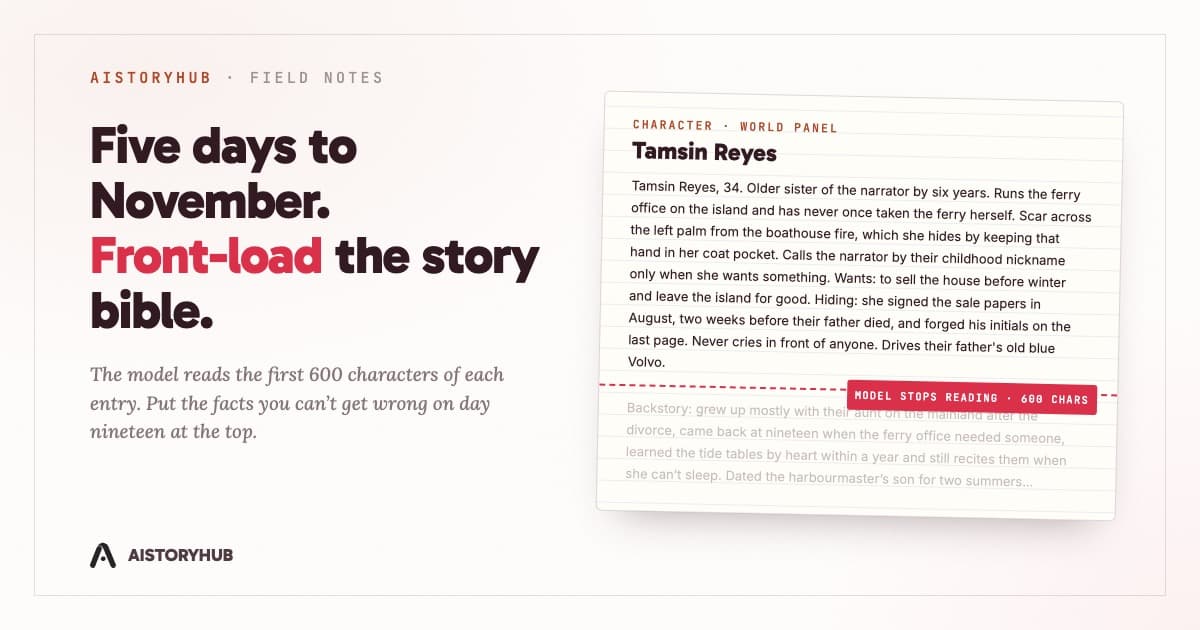
Here's the detail that changed how I write character entries. When a chapter is generated, each character's description goes into the prompt, but only the first 600 characters of it. That's roughly a hundred words. Everything past that point is for you, not the model.
So put the load-bearing facts first. Age, relationship to the protagonist, the one physical detail that will come up, the thing they want, the thing they're hiding. Backstory that only matters in chapter 22 can go further down, or in a separate entry you attach when chapter 22 comes around.
Each character entry also has four short voice fields: dialogue style, speech patterns, vocabulary, and accent or dialect. These go into their own section of the prompt, and the model is told they override the general style for that character's dialogue. Fill them for your main three or four people. "Answers questions with questions" or "never uses contractions when angry" does more for a character than a paragraph of personality traits, and it's the fastest fix for the problem I wrote about in why every AI character talks the same.
One more thing the prompt tells the model: the characters in your bible are the only named characters. If you want a landlady, a rival, a bartender with a name, add them, even as a one-line entry. Otherwise expect the model to work around them.
Day three: the world, but only what you'll reuse
The World panel holds characters plus seven other entry types: species, locations, lore, organizations, items, events, and notes. Six of those seven (everything except notes) get assembled into a section the prompt labels as established canon, with a firm instruction: never contradict, rename, or reinvent them, and don't introduce new named locations, factions, species, or items beyond what's there unless the task asks for it.
That instruction cuts both ways. It's what keeps the model from renaming your capital city in chapter 12. It's also why you shouldn't leave the world completely empty if your story needs places. A bible with no locations means the model will avoid naming places at all, or you'll have to ask for each one explicitly.
Size matters here too. If you have 18 or fewer of these world entries, every one of them goes into every prompt in full (again, the first 600 characters of each). Past 18, the system gets selective: entries whose names appear in the chapter's request, its beats, the spine, the previous chapter, or the character list get their full description, and the rest are listed by name only. For a November draft, I'd aim to stay at or under 18. It's enough for a city, a few key places, a faction or two, and the handful of objects and history the plot hangs on. If you need more, name your entries distinctively, because the matching is on the name appearing in that text.
Notes are the exception. They're not part of that automatic canon section, which makes them the right place for your own working thoughts: alternate endings, a list of scene ideas, the research you might need. If one becomes relevant to a chapter, attach it as a reference for that chapter.
Day four: three or four Story Rules
Story Rules sit at the bottom of the World panel, and they go into the prompt under a heading that says "always follow." That makes them the most powerful text in your bible, and the easiest to overuse. A rule like "first person, past tense, Ada's point of view only" or "no magic is ever explained in narration" is exactly right. A rule like "write beautifully and avoid clichés" does nothing except take up room.
Write rules for things the model will otherwise get wrong on its own: tense, point of view, a content line you don't want crossed, a naming convention, a recurring constraint of the setting. If you can't picture the specific mistake a rule prevents, cut it.
Day five: decide what to leave open
This is the part people skip. The bible holds what's decided. Anything you write there becomes canon the model is told not to contradict, so don't write down things you haven't decided yet just to make the bible feel complete.
Things I'd leave open on November 1: the midpoint twist, if you only have a vague one. Secondary characters' backstories. The exact geography of anywhere you haven't written a scene in yet. How the antagonist's plan works in detail. You'll discover most of these while drafting, and you want room to.
When you do discover something mid-month, the rule is simple: if it's going to come up again, add it to the bible the same day. The cross-chapter memory that feeds each new chapter is built from your canon chapters' saved beats, so the story itself carries a lot of continuity forward. But a fact buried in chapter 9 is weaker than a fact sitting in a world entry, because the entry is in front of the model every time.
And if you want to try something wild mid-month without committing to it, mark that chapter as a sandbox. Sandbox chapters don't feed the continuity of the chapters that come after them. I wrote about the difference between canon and sandbox chapters in September, and the timing of that feature is about right for week three of a month-long sprint.
What you end up with
Five days of this should give you a spine of five or six sentences, three to six characters with front-loaded descriptions and voice fields, under 18 world entries, three or four rules, and a Notes folder full of things you deliberately didn't decide. That's maybe two thousand words of setup. It won't feel like enough, and that's fine. You'll learn the book by writing it. The bible is there so that when you or the model writes chapter 19, nobody has to guess the sister's age.
If you're starting a new story for November, the word goal on a story includes a 50,000-word preset. Set it, fill the spine, and leave the rest for November to tell you.