Blog · craft · dialogue
The Dinner Table Scene: Why AI Flattens Ensemble Dialogue
JP LeBlanc · · 5 min read
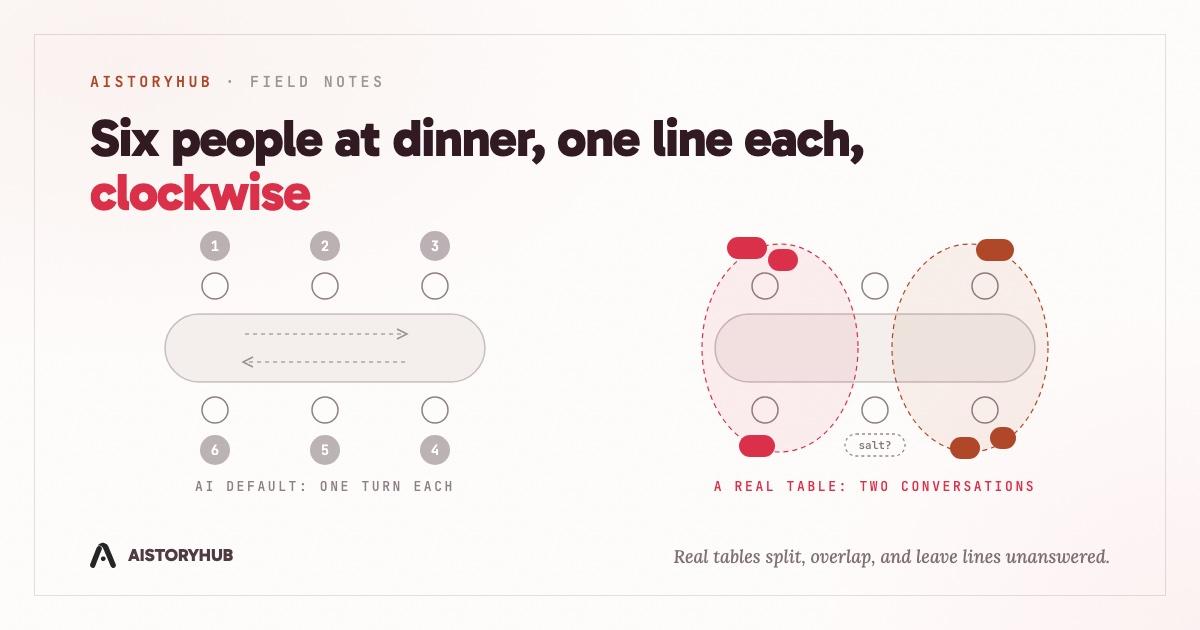
Ask a model for a holiday dinner scene with six people at the table and you'll get a meeting. Everyone waits their turn. Each person says one complete sentence, aimed at the person who spoke before them. The conversation moves clockwise around the table like a talking stick, and every line is about the same topic. Somebody raises a glass near the end.
Today is American Thanksgiving, so a lot of people are about to sit at a real version of that table, and it will sound nothing like that. Two conversations will run at once. One person won't speak for twenty minutes and then say the only thing anyone remembers. Somebody will answer a question nobody asked them. It's worth listening for, because the ensemble scene is the one place where AI dialogue fails in a way you can diagram.
What the round-robin looks like
"This turkey is amazing, Mom," said Leah.
"Thank you, sweetheart. I've been up since five," Carol replied with a warm smile.
"Speaking of early mornings, how's the new job, Marcus?" asked Uncle Ray.
"It's been challenging but rewarding," Marcus said. "I'm learning a lot."
"That's wonderful," Grandma June said, her eyes twinkling. "We're all so proud of you."
Theo, who had been quiet, finally spoke up. "I have an announcement."
Six speakers, six lines, one per person, in order. Every line is a direct, grammatical response to the line before it. "Speaking of" carries a topic change, the way an agenda item would. And the quiet character gets a narrated label ("who had been quiet") followed immediately by the plot. Nothing is overheard, nothing is missed, and nobody is talking about anything except what the scene needs next.
I wrote about the single-pair version of this problem in Why Every AI Character Talks the Same: one voice wearing two name tags. The ensemble version is worse because it compounds. Six people with one voice, taking orderly turns, is a panel discussion.
Why models do this
A chat model is trained on turn-taking. Its entire life is a conversation where one party speaks, then the other, and every message responds to the last one. That's the shape it knows best, and when you ask for six voices, it serves them through the same shape: one turn each.
There's also a legibility instinct at work. Overlapping speech is hard to follow on the page, and the model is optimized to be easy to follow. It will always choose the version where you know who said what and why. Real dinner tables aren't legible. The mess is the point.
How a real table works
A few things that are true of almost every family dinner and almost never true of a generated one:
- The table splits. Past four people, conversation fractures into two or three clusters by seating. The ends of the table can't hear each other. People drift between clusters when something louder catches their attention.
- Lines go unanswered. Someone asks for the salt and nobody hears. Someone makes a joke and only one person laughs. In a generated scene, every line gets a response, because a response is the next turn.
- People talk to objects and animals. The dog, the gravy, the kid's spilled milk. Half of real dinner speech is logistics.
- Everyone has an agenda for the meal. Somebody has news. Somebody else is dodging a question about their divorce, and the host mostly wants everyone to eat before it gets cold. The agendas run under the small talk the whole time and surface in what people steer toward or away from.
- Interruptions are uneven. Some people interrupt. Some never do. Some get interrupted every time and stop trying.
The same scene, rebuilt
Ray was telling the story about the deer again, the one where the deer gets bigger every year, and Leah had stopped listening at the antlers.
"You're not eating the sprouts," Carol said to Theo, and Theo said he was, and moved one.
At the far end Marcus was explaining his job to Grandma June, who had asked a simple question and was now getting the long answer. "So it's more like a platform," he was saying. "Do you know what a platform is." June said she'd been on one at Union Station in 1958.
"Twelve points," Ray said. "Twelve."
"Somebody pass the gravy before it sets," Carol said, and nobody did, and she got up and got it herself.
Theo put his fork down. Leah noticed, because she was the only one not talking, and she watched him take a breath and then not say whatever it was. He picked the fork back up.
What changed:
- Two clusters run at once: Ray's deer story near Leah, and Marcus with June at the far end. The scene cuts between them by proximity, the way your attention would.
- The point of view belongs to one person. Leah hears what Leah can hear. That's the filter that makes overlap readable. She's not listening to Ray, so we get Ray in fragments.
- Carol's line about the gravy goes unanswered, and her getting up herself says more about her week than any dialogue would.
- Theo's announcement doesn't happen. He almost does it. The reader now knows there's an announcement, and so does exactly one person at the table. The model's version spent that tension in one line.
Practical moves
Pick a listener before you write. In an ensemble scene the point of view character is also the microphone. Decide what they're trying to hear and what they're trying to tune out. Everything else arrives in fragments.
Write each character's agenda on a sticky note. One line per person: what they want from this dinner. Then check every line of their dialogue against it. A line that serves nobody's agenda is either logistics (keep it, it's texture) or the model filling a turn (cut it).
Let at least one line die. Somebody says something and nobody answers. It's the cheapest way to break the turn-taking rhythm, and it reads as real instantly.
Give the quiet character something to do with their hands that isn't a stock gesture. Not a clenched jaw. Moving one sprout. Folding a napkin into smaller and smaller squares.
If you generate the scene, say so in the prompt. Models follow structure instructions much better than vibe instructions. "Two separate conversations at opposite ends of the table, the POV character overhears both in fragments, at least two lines go unanswered, Theo says nothing until the last paragraph and then doesn't make his announcement" gets you far closer than "make it feel chaotic and real."
Where the story bible helps
The structural fix is yours to make. Voice, though, is something you can set once per character and stop re-explaining. In a story's World panel, every character has fields for Dialogue style, Speech patterns, Vocabulary, and Accent or dialect, and a Generate with Ash button that drafts a first pass at them from the character's profile. Those fields travel into generation with the rest of the character, so Ray can keep telling the deer story the same way in chapter twelve.
Six distinct voices still won't fix a clockwise conversation. But with the voices pinned down, your revision time goes to the table's shape instead of to making Grandma June stop sounding like Marcus. Then, after you've rewritten it, run the Editorial Pass on the chapter: dialogue is one of the categories it reports on, and it's a decent second ear for the lines that still sound like turns.