Blog · feedback · product
Private Reading Groups: Getting Real Readers on Your Draft
JP LeBlanc · · 5 min read
I meant to write this post about critique groups inside AIStoryHub. Then I reread the code for Groups before describing it, which is a habit I'd recommend to anyone writing about their own product, and the honest name for what we built is a private reading group. That's narrower than a critique circle, and for getting a November draft in front of people it turns out to be the more useful thing. So this is a post about what Groups does, what it doesn't, and how to run real feedback through it anyway.
What a group actually is
A group is a named list of readers that you own. You create it from Groups in the sidebar, give it a name ("Tuesday writers," "Mom and the cousins," whatever), and invite people by email. Each invited person gets their own link in their inbox. There's also one shared group link you can copy and paste into a group chat if you'd rather not collect emails.
Readers don't need an AIStoryHub account. They click the link, they see the stories you've published to that group, they read chapters in order, and at the bottom of each story they can leave a comment. Comments take an optional name (it defaults to Anonymous) and support replies, so a thread can actually go back and forth between you and a reader, or between two readers.
You publish a story to a group from the story's Publish panel, under Private group. When you do, every invited member gets an email saying there's something new to read. Unpublish it and it disappears from the group's page.
Two details I didn't know myself until I checked:
- Readers see your current canon chapters, live. If you fix chapter four on Wednesday, Thursday's reader gets the fixed version. There's no frozen copy to republish.
- Sandbox chapters never show up. The query that serves chapters to a group filters to canon only, so your experiments stay private even when the story they live in is shared. (If you haven't used sandbox chapters, this post explains them.)
The part I'd use most: where readers stopped
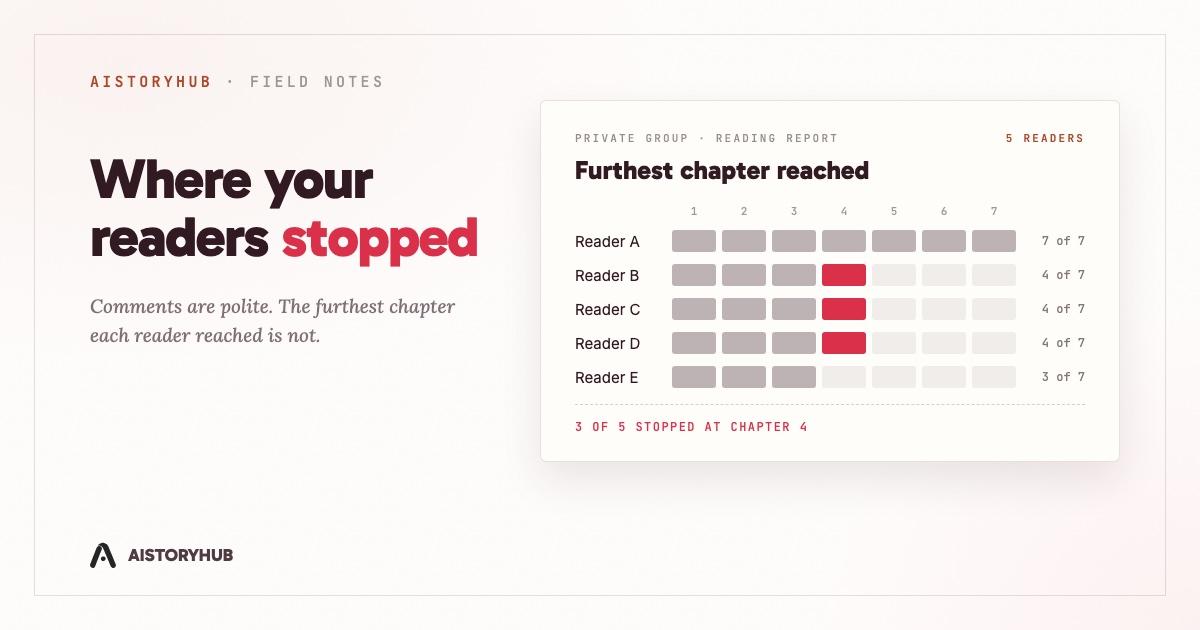
Each group has a small reading report per story. For every invited member it shows how many times they opened the story and the furthest chapter they reached, out of how many chapters exist. It also splits opens between invite links and the shared link, so you can tell whether the cousins are reading or whether your group-chat link went somewhere else.
That "furthest chapter" number is the least polite feedback a draft will ever get. People are polite in comments. They are not polite with their attention. If four of five readers reached chapter 7 and one reached chapter 3, that's one reader's taste. If all five stopped between chapters 4 and 5, you have a chapter 4 problem, and no amount of "I really liked it!" in the comments changes that.
I'd read that report before reading any comments. It tells you where to look, and the comments tell you why.
What it isn't
Being precise, since the topic of this post was supposed to be something else:
- Comments attach to a whole story. There's no inline commenting on a specific paragraph or line inside a group. A reader who wants to flag a sentence has to quote it.
- Only the group's creator publishes stories into it. Members read and comment. There's no shared pool where five writers each post a chapter.
- Nothing schedules or enforces a swap. If you want reciprocity, people have to organize it themselves.
That last point is the important one if you came here looking for a critique group. The workaround is simple and it works fine: every writer in the circle creates their own group and invites the others. Five writers, five groups, everyone a reader in four of them. Each writer gets their own reading report, which is better than a pooled one anyway.
Running a critique round that produces usable notes
The tool is the easy part. Most critique rounds fall apart over the questions the writer asks, or doesn't. A few things I've learned from being on both ends:
Send fewer chapters than you think. Three chapters that people finish beat twelve that people abandon. The reading report will tell you who finished; give it something finishable.
Ask specific questions in the first comment. Post your own comment on the story before anyone reads it, with two or three questions you actually want answered. "Did you believe Ana would leave in chapter 2?" gets a usable answer. "Thoughts?" gets "I liked it."
Ask where they got confused, not what they'd change. Readers are excellent at reporting their own confusion and bad at prescribing fixes. "I lost track of who Pell was" is gold. "You should cut Pell" is a guess about the cause of a symptom you can diagnose better yourself.
Ask about the stopping point directly. If someone's furthest chapter is 3 of 6, it's fine to reply and ask what happened at 3. Sometimes it was a busy week. Often it wasn't, and they'll tell you if you ask without defending the chapter.
Don't reply to defend. The reply thread is for clarifying questions. Explaining what you meant teaches the reader to give you less next time.
Where machine feedback fits
Human readers are the only source of "I stopped here." Machine feedback is good at the things readers notice and can't name, and at the continuity slips readers don't notice at all. Inside a story's editor, the Editorial Pass reads one chapter against your story bible and returns notes tagged by category (pacing, voice, continuity, dialogue, clarity, structure, characterization), each with a confidence level, plus a short list of what's working that a revision shouldn't break.
I'd run that before sending chapters to a group, not instead of it. Fix the continuity errors a model can catch, so your readers spend their attention on the questions only a person can answer: did this hold me, and where did it stop.
If you have a draft from November sitting in a folder, the shortest path is to create a group with two or three people you trust, publish the first three chapters, and look at the reading report in a week. Groups lives in the sidebar, under Groups.