

comparisons · pricing · voice
Sudowrite, Novelcrafter, or AIStoryHub? An Honest Founder's Guide
JP LeBlanc · October 5, 2026 · 6 min read
Voice fidelity: whose prose sounds like you
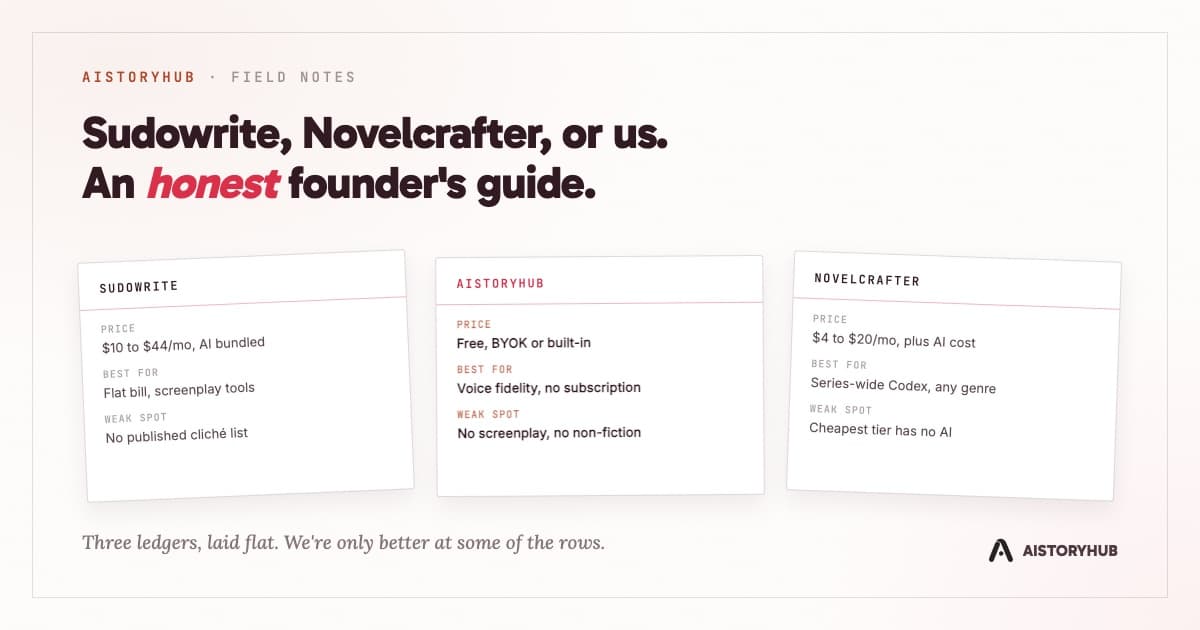
When I started drafting our Sudowrite comparison, I wanted to claim voice fidelity as something only AIStoryHub does. That turned out to be false, and it would have been dishonest to publish it anyway. Sudowrite's Write tool and Story Bible genuinely personalize toward your style, reading your characters, tone, and plot arc before it generates a line. AIStoryHub's Voiceprint does something similar, built as controls you set directly: tone, pacing, point of view, and a specific list of words you've banned from your own prose. The honest distinction isn't that one of us cares about voice and the other doesn't. It's that AIStoryHub publishes its receipts and Sudowrite doesn't: a 758-entry corpus of AI clichés, tagged by category and confidence, sitting at aistoryhub.co/corpus for anyone to search or download. With Sudowrite's personalization, you're trusting the mechanism. With ours, you can audit it.
Novelcrafter skips this argument entirely, and that's a legitimate choice, not a gap. Its own positioning is that you're in control of how much AI you use, framed as optional assistance rather than a prose-quality promise. If your actual complaint is that AI fiction sounds generic, Novelcrafter isn't trying to solve that problem, and it doesn't claim to.
Then there's writing straight into ChatGPT or Claude, which is where most people start and where most of the "this sounds like AI" complaints come from. A blank chat window gives a model nothing but your prompt, so it defaults to the statistically safest version of good prose: the same handful of sentence patterns, the same rhetorical moves, every time. Nothing about your voice persists between sessions either. You re-explain your style in every new chat, which most writers simply stop doing by the third chapter.
Story bible and canon: what holds a novel together
Novelcrafter's Codex is the strongest tool of the four for pure organization, and I'd say that even if it cost me the sale. It's a wiki-style system for characters, locations, and lore with automatic linking, shareable across an entire series, and it isn't limited to fiction: non-fiction, poetry, screenplays, and business writing all live inside it. If you're several books deep and need one trustworthy place holding the whole continuity together, Codex is built for a more general version of that job than AIStoryHub attempts.
AIStoryHub's structure is narrower on purpose. Full scene and chapter version history with instant revert, an @-reference system for keeping characters and places consistent, and two additions aimed at planning rather than reference. You write a whole-book Story Skeleton (logline, theme, arc, where it's heading) and plan beats chapter by chapter, then Generate Draft from Outline walks that chapter map in order and drafts every beat-planned chapter in one pass, anchored to the skeleton, the world bible, and how the previous chapter ended. The Variables Engine lets you drop any character, location, or lore entry into a Story Rule or a reusable instruction by name, with {{#if}} conditional logic so a rule only fires when it's relevant to the scene it touches. That conditional matching took longer to ship than I told our first users it would; getting it to behave against messy real chapter drafts, not clean test cases, kept turning up edge cases I hadn't planned for. Novelcrafter's Codex doesn't have that conditional layer or a one-pass drafting runner. It's deep on reference, not on turning a plan into a draft automatically.
Sudowrite sits between the two: a Story Bible for outline and continuity that you expand into a draft yourself, tool by tool, without the beat-driven bulk runner or the conditional variables either side of it has. ChatGPT and Claude, used directly, have none of this structure at all. A chat thread isn't a manuscript. Long projects sprawl across conversations, context gets lost between them, and you're the one carrying the continuity in your own head.
The cost model: what you're actually paying for
AIStoryHub charges nothing at any tier. Bring your own API key and pay Anthropic, OpenAI, or Google directly at their published rate (a full chapter with Generate PRO runs about four cents, a heavy two-hour session about a quarter), or skip the key entirely and use the free built-in model.
Sudowrite runs $10 to $44 a month with AI access bundled in: $10 for 225,000 credits aimed at hobbyists, $22 for the tier it recommends for an actual novel, $44 for authors publishing several books a year. Novelcrafter is bring-your-own-key too, which sounds identical to AIStoryHub until you notice it still charges $4 to $20 a month for the platform on top of whatever you pay your provider, and its cheapest $4 tier doesn't include AI at all. ChatGPT Plus and Claude Pro run $17 to $20 a month flat, covering everything you use the model for, not just fiction, so the comparison cuts against them a little in reverse: you're paying for a general tool and getting fiction as one use among many.
If cost decides this on its own, that's the whole conversation. It usually shouldn't.
Workflow: where you sit while you write
Sudowrite and Novelcrafter are both browser tools, full stop. You open a tab and work inside it. AIStoryHub runs an actual MCP server, the same protocol Anthropic ships for Claude, so Claude Code, Claude Desktop, Cursor, or ChatGPT's own Developer Mode connectors can call your account directly: list your stories, pull world-bible context, generate or revise a scene, run a self-check pass, all without a browser tab open. If you already live inside an editor or an agent all day and resent switching tools to write fiction, this is the difference that has nothing to do with voice or price. See aistoryhub.co/install-mcp for the setup; it takes a couple of minutes.
Community is smaller but worth naming honestly too. AIStoryHub has public groups, a universe gallery you can fork with one click into your own story, and beta-reader groups with progress tracking. Novelcrafter has a $20 team tier built for co-authors rather than a public community. Sudowrite doesn't emphasize this layer at all; it's a solo tool, and if that's what you want, its focus there is a feature, not a gap.
So, honestly, which one
Pick Novelcrafter if organization is your real bottleneck: a sprawling series, a wiki you can trust, or work that spills outside fiction into non-fiction or screenplay. Its Codex does a harder, more general job than anything AIStoryHub or Sudowrite attempts, and no amount of voice tooling replaces that if reference tracking is what's slowing you down.
Pick Sudowrite if you'd rather pay a flat monthly bill than manage an API key, or if you specifically want its Brainstorm and Expand workflow or its screenplay conversion, neither of which AIStoryHub offers.
Pick AIStoryHub if the actual problem is that AI-written fiction keeps sounding like AI-written fiction, and you don't want a subscription just to find out whether that's fixable. That's the whole bet the product is built on, and it's a narrower bet than either of the other two. We don't do screenplays. We don't do non-fiction. And if you're managing four books in one continuity, Novelcrafter's Codex will serve you better right now than our reference tools will.
None of these are close enough to call in general. Read the full breakdowns before you spend an afternoon committing to any of them: /vs/sudowrite, /vs/novelcrafter, and /vs/chatgpt walk through the rows I didn't repeat here.