

ai writing · tools
Blind Taste Test: What Showdown Tells You That Benchmarks Don't
JP LeBlanc · November 8, 2026 · 4 min read
Benchmarks answer a question about the average. Run a few hundred prompts through a model, score every output on a fixed rubric, publish the mean. Our own Fiction Slop Index works that way, and it's the right tool for "which model writes fewer tells on average." It's the wrong tool for a narrower question that matters more when you're actually writing: given this prompt, which of these two paragraphs would I keep?
Showdown is built for the narrow question. It's a public page, free, no account needed to try. I want to describe exactly what it runs, including what it can't tell you, because a taste test is only useful if you know what's in the cups.
What happens when you press the button
You type a prompt (or take one of the suggestions: a betrayal, a cyberpunk hacker, a wizard stuck as a house cat, an argument about pineapple on pizza). Two drafts of about 200 words each generate in parallel.
The left-hand "Generic AI" side gets a deliberately ordinary instruction: write a creative story based on the prompt, about 200 words, using standard creative writing techniques. That's roughly what most people type into a chat window.
The Ash side gets what our generation pipeline gives a scene. That means the anti-cliche instructions built from our corpus, a specificity protocol, and a short list of structural requirements: vary sentence length hard, keep subtext instead of naming feelings, end on something concrete, don't stack two metaphors that say the same thing. After the draft comes back, it goes through the same structural self-check and redraft loop the product runs on generated chapters. A critic reads the draft for structural tells, flagged spans get rewritten from their intent, and a rewrite is kept only if the check says it didn't make anything worse.
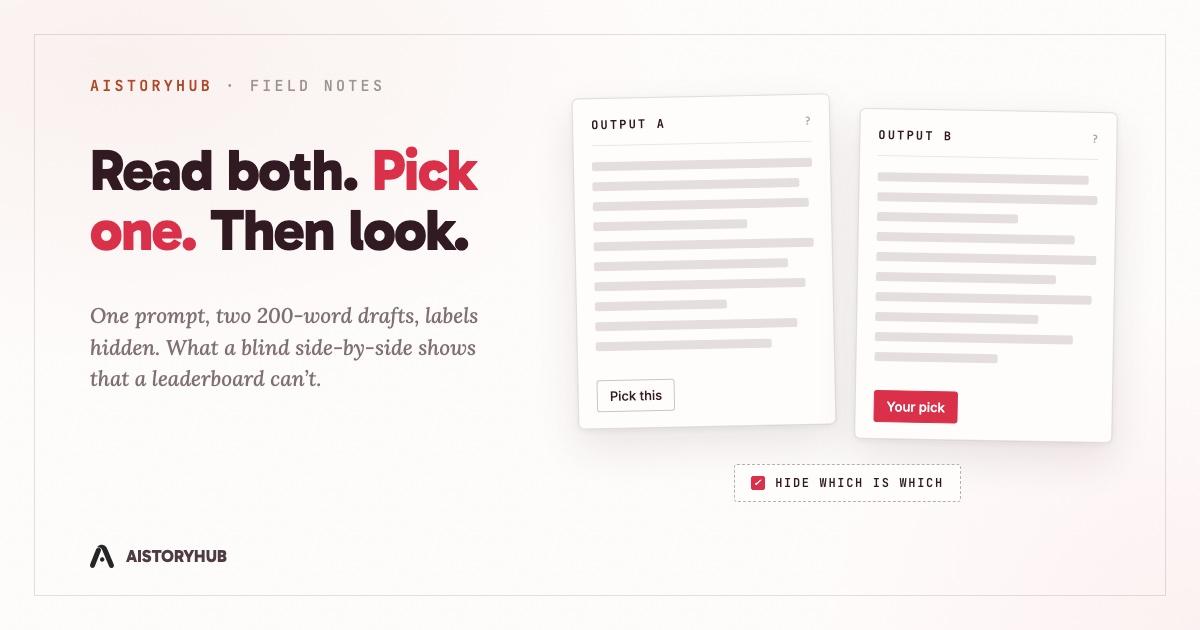
Tick "Hide which is which and let me guess" before you generate and the two drafts land in random order, labeled Output A and Output B. Pick one, then press reveal.
The caveats
Both sides run the same model. If you're not logged in, Showdown runs both drafts on Claude Haiku 4.5 through our gateway. Signed in, both run on the prose model you've connected through your own key, which spends a little of your own tokens. Either way, the only thing that differs between the two drafts is the pipeline, which is the thing you're there to judge.
Punctuation is evened out. Our pipeline bans em dashes, so both blind drafts get the same dash cleanup before you see them. A long dash won't tell you which side is which. Read for what the sentences do.
Two hundred words is short. Some tells only show up over length. Rhythm is the obvious one; a 200-word draft has maybe a dozen sentences, which isn't enough to see a cadence settle in. Showdown is good at revealing phrase-level and image-level differences, and weak at revealing chapter-level ones.
One run is noise. Both sides are sampled. Run the same prompt twice and you'll get different drafts, sometimes with the winner flipping. Sometimes the generic side wins. That's fine, and it's useful to know which prompts it wins on.
How to run a taste test worth doing
If you want an answer you can use, run it like an experiment instead of a demo.
- Use prompts from your own book. "Two estranged sisters clean out their mother's pantry and argue about expiration dates" tells you more than a stock genre prompt, because you already know what the scene needs.
- Turn on blind mode every time. Knowing which side is which changes how you read. It's hard to be fair to a draft labeled "Generic AI."
- Read both aloud before choosing. Your ear catches the glide of same-length sentences faster than your eye.
- Write one sentence about why, before you reveal. "B let the argument stay about the pantry." "A had the better last line." The reasons are the real result.
- Do at least five, across scene types. Mix a dialogue scene, an action beat, a quiet interior moment. Tally the picks and reread your one-line reasons together.
The reasons tend to cluster. You might find you always pick the draft that ends on an object, or the one with less interiority, or the one that never says the emotion out loud. That pattern is your taste, written down. It's more actionable than any leaderboard because it's about you.
What a saved vote does
After you pick, you can save the result. Saving needs an account, and it records the prompt, both drafts, and your pick. It also stores which side you preferred as a preference on your account. If it's your first saved vote and you haven't built a writing style yet, saving sends you to Style Lab to set one up, which is the natural next step: if your one-line reasons say you prefer low emotional directness and concrete endings, that's exactly what the dials there control.
What benchmarks still do better
None of this replaces a benchmark. If you're choosing which provider to put a key in for, averages over hundreds of prompts tell you more than your five votes. The Slop Index methodology explains how we score those, and this post covers why we built it. Use the index to pick a model. Use a blind taste test to find out what you like, on prompts you care about.
If you have ten minutes this weekend, take five prompts from your current project to Showdown, tick blind mode, and keep the five sentences.