Blog · november · drafting · writing craft
Stuck at 25,000 Words: The Mid-November Stall and Three Ways Out
JP LeBlanc · · 5 min read
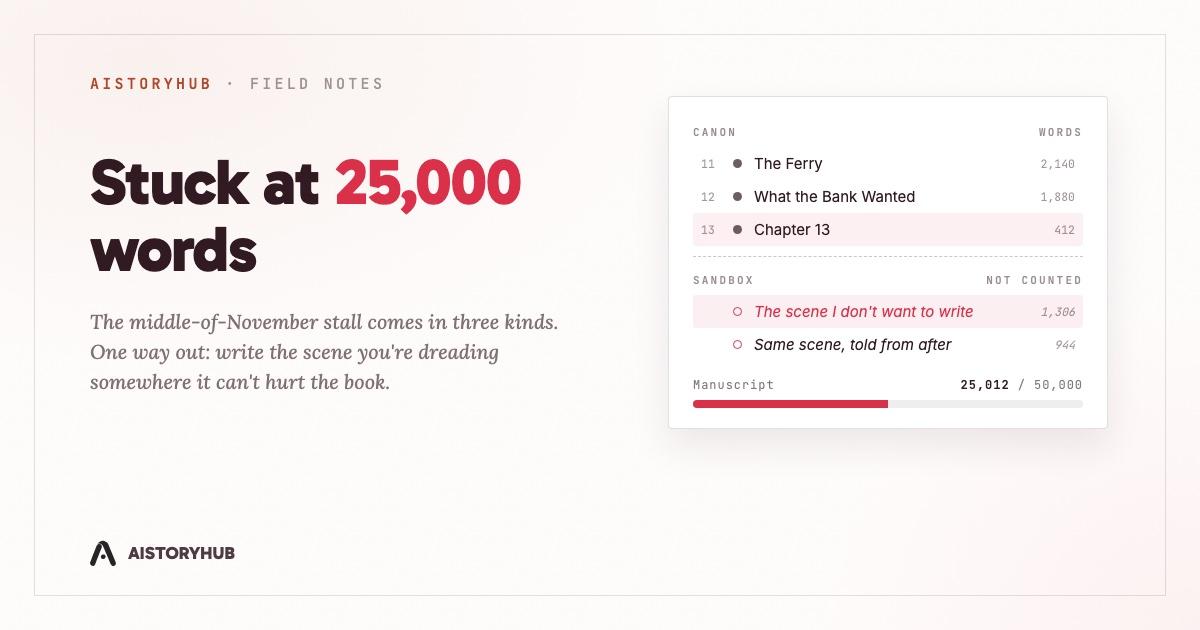
If you started a 50,000-word draft on November 1 and kept pace, today you're somewhere around 25,000 words. If you didn't keep pace, you're behind, and you know exactly by how much, because the arithmetic is the one part of this month that never gets fuzzy.
The middle of a first draft is where a lot of them stall. You've used up the energy of the opening. The ending is still far enough away that you can't see it from here. Every scene you write now has to carry the story forward without the help of a premise that still feels new, and the scenes don't always agree to.
The stall at the midpoint isn't one problem, though, and the fix depends on which one you have.
Figure out which stall it is
Open the draft and try to write one sentence describing what happens in the next scene. Then notice what stops you.
If you can't write the sentence, you don't know what happens next. The story has run out of road, and no amount of discipline will produce a scene you haven't imagined yet.
If you can write the sentence easily and still don't want to write the scene, you know what happens and something about it is wrong. Maybe it's a scene you've been dreading: a fight you don't know how to stage, a death, a conversation between two characters who haven't been in a room together yet. Or maybe your gut has already decided the plan is wrong and hasn't told you why.
If the problem isn't the next scene at all, and every time you open the file you think this whole book is bad, that's a third thing, and it's the one that lies.
Way out one: skip ahead and leave a note
When you don't know what happens next, stop trying to find out in order. Write the next scene you can see, even if it's six chapters on. There's usually at least one later scene you've been looking forward to since October. Write that.
Leave a plain marker where the gap is, something like [Agnes gets from the city to the coast somehow. Figure out in December.], and keep going from the scene you can see. Writing a later scene often tells you what has to be true before it, and once you know that, the gap usually shrinks. If it doesn't, you'll have a much more specific problem to solve in revision than "I don't know what happens."
If you use Ash, this is a fair place to ask for help, as long as you ask for options. "Give me five ways Agnes could get from the city to the coast that cost her something" is brainstorming; you're still choosing. "Write the chapter where Agnes travels to the coast" gets you 3,000 words you didn't decide on, and in December you'll be revising a scene you never chose.
Way out two: write the scene twice, and keep one
When you know what happens and don't want to write it, the cheapest experiment is to write it a different way and see which version you believe.
This is what sandbox chapters are for. In the file browser, chapters sit in two groups, Canon and Sandbox, and there's a button to add a chapter straight into Sandbox. A sandbox chapter can see your real story: when you generate into it, it gets the canon chapters before it, your characters, your world. But nothing written in a sandbox chapter feeds into the generation context for later chapters, and the continuity checker ignores it. (Ash's chat briefing does include sandbox chapters, which is handy when you want to talk through two versions side by side.) If the fight goes badly in the sandbox version, nothing downstream ever knew it happened. The full mechanics are in canon vs. sandbox chapters.
So write the dreaded scene as planned in one sandbox chapter. Then write a second version where the thing you're dreading doesn't happen, or happens to a different character, or happens offstage and the scene opens on the aftermath. Read both. Usually one of them is obviously alive and the other is obviously dutiful. Drag the alive one into Canon.
One honest catch for anyone tracking a word count: sandbox chapters don't count toward the manuscript total. That's deliberate (an abandoned experiment shouldn't inflate the number you show anyone), but it means the afternoon you spend on two versions of chapter 14 won't move your counter until you promote one. If the count matters to you this month, keep your own tally of sandbox words somewhere. They're real words. You wrote them.
Way out three: lower the stakes of the next hour
When the problem is this whole book is bad, don't argue with the feeling. At 25,000 words, almost every draft reads worse than the book in your head, because the book in your head has had a month of revisions you haven't typed yet. A first draft at the midpoint is supposed to be uneven. That doesn't tell you much about what the finished book can be.
What helps is making the next session small enough that the feeling doesn't get a vote. Some versions of that:
- Write only the last line of the next scene. Then write toward it.
- Write the next scene as dialogue only, no tags, no description, and fill in the rest tomorrow.
- Set a goal of 300 words instead of 1,667. A small number you hit often grows into a bigger one. A big number you miss usually ends the session.
- Reread your opening chapter and nothing else. There's usually something in it you've forgotten you planted, and it's usually something the middle can use.
What I'd avoid is the move that feels most productive: going back to revise chapter one. It's the part of the book you understand best, so it's the most comfortable place to be, and you can lose a week polishing a chapter whose job may change completely once you know the ending.
Where AI makes the stall worse
There's an obvious shortcut at 25,000 words: have the model write the middle so you can get to the parts you care about. I'd be careful with it. The middle is where a book figures out what it's about. The midpoint usually turns on something the protagonist learns that changes what they want, and that discovery usually comes out of the writing itself. A generated middle gives you scenes in the right order with the right characters, but it doesn't make that discovery for you.
The model is good company for a narrower job. Ask it what's missing from the middle. Ask it to list the promises your opening made that the story hasn't paid off yet. Ask what each secondary character wants right now and whether any of those wants are in conflict. Questions like that come back as material you can use. The draft stays yours.
One practical thing for tonight
In AIStoryHub, you can set a word goal on any story (there's a 50,000-word preset). If you haven't, set it, then make one sandbox chapter called "the scene I don't want to write" and write a bad version of it. Bad on purpose, as fast as you can. Then decide tomorrow whether it goes in Canon.