

ai slop · ai writing tells · tools
Red, Orange, Yellow: How to Read the Slop Checker
JP LeBlanc · November 14, 2026 · 5 min read
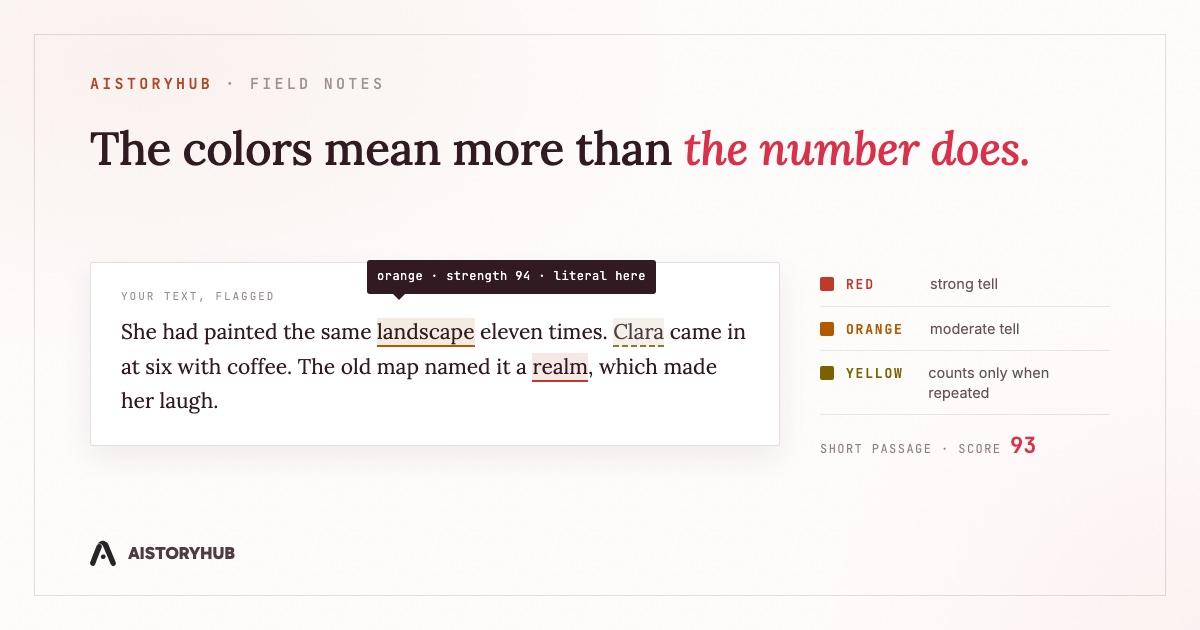
I pasted a 73-word paragraph into the Slop Checker while writing this post. A painter, a gravel pit, two cranes, a dealer who wants people in the picture. I wrote it myself, specifically to be plain. It scored 93 out of 100, Peak AI Slop, the top tier.
One word did that: landscape. The painter had painted the same landscape eleven times. In the corpus, "landscape" is an orange-tier tell with a strength of 94, because models reach for it constantly as a metaphor ("the evolving landscape of publishing"). In my paragraph it meant an actual painting of actual land.
The checker wasn't broken. It was answering a narrower question than the one I'd asked it, and reading it well means knowing which question that is.
What the three colors mean
The checker matches your text against the Corpus of AI Clichés, version 1.8, which currently has 758 entries. Every entry carries a confidence tier, and the corpus file defines them in one line: "red=strong tell, orange=moderate tell, yellow=context-dependent (overuse only)." Of the 758, 359 are red, 300 are orange, and 99 are yellow (counted from public/ai-cliches-corpus.json, which you can download from /corpus).
Each entry also has a strength score from 0 to 100. The tiers overlap more than you'd guess. Red entries run from 65 to 99. Orange runs from 50 to 94, which is how "landscape" ends up stronger than most reds. Yellow sits between 30 and 50.
On the results page, every match is highlighted in its tier's color. A solid underline means the match counted toward your score. A dashed underline means it was found and shown but didn't count. Hover any flagged word and you get the term, the tier, the strength, and how many times it appears.
How the number gets built
The score is about density. The checker adds up the strength of every counted match, divides by your word count in thousands, and squashes the result onto a 0 to 100 curve. A few rules adjust the sum first:
- Yellow terms only count from their second appearance. One use is shown, dashed; two or more and it counts.
- Repeats count, but less. Each repeat adds half the term's weight, capped at three times the original, so one word used fifty times can't own the score on its own.
- Since version 1.8, every entry has a lifecycle as well as a tier. Eight entries are marked fading, the over-publicized 2023-24 vocabulary like "delve," "tapestry," and "pivotal," and they count at half weight. "Em-dash overuse" is the only entry marked red herring, because current models now underuse the em dash, and it counts at a fifth.
The verdict labels map onto the number: under 15 is Reads Clean, 15 to 34 is Mostly Clean, 35 to 54 is Some Tells, 55 to 74 is Heavy AI Styling, and 75 or more is Peak AI Slop.
Short passages exaggerate
Because the score is per thousand words, the length of what you paste changes what a single hit means. Run the arithmetic on that one "landscape":
- In my 73-word paragraph: 93, Peak AI Slop.
- In a 1,000-word passage with no other matches: 48, Some Tells.
- In 2,000 words: 32, Mostly Clean.
Same word, same strength. The tool will run on as few as 20 words and accepts up to 5,000. Below a few hundred, read the highlights and treat the number as noise. If you want a score you can compare from one draft to the next, paste a whole scene, and paste the same scene each time.
False positives, and when to ignore a flag
A flag says the phrase shows up far more often in AI output than in human writing. Whether it's a problem in your sentence is a separate question, and only you can answer it. Some patterns I'd ignore without guilt:
The word is literal. A landscape painter paints landscapes. A fantasy novel can have a realm in it, even though "realm" is red at 91. The tell is the figurative, decorative use: "the realm of possibility," "navigating the landscape." If you could swap the flagged word for a plainer one and lose meaning, keep it.
It's a name you chose on purpose. The corpus has a names category because models default to the same handful of character names. "Elara" is red at 90. "Clara" is yellow at 30, so one Clara does nothing. I wrote a 28-word passage that used "Clara" four times, and it scored 96. If your protagonist is named Clara, every scene with her will light up yellow, and the score will tell you nothing about the prose around her. If she's named Elara, it's worth asking where the name came from. If you picked it, keep it. If a model suggested it, at least know that a lot of readers have met her before.
A character would really say it. Dialogue from a consultant who talks in buzzwords is supposed to sound like that. Our own revision skill for Ash, The Tell, is told to leave a flagged phrase alone when it's "doing real narrative work" and to say why.
Some flags I wouldn't ignore. Stock images in narration are the clearest case: "let out a breath she didn't know she was holding" is orange at 72, and I've never seen it do work a plainer sentence couldn't. Body language, weather, light through windows: when the corpus flags those, it's usually right, and you'll find more on why in the post on the 758 phrases.
Read the page in this order
The number is the least useful thing on the results page, so I read it last.
- Top offenders. Counted matches come first, then sorted by strength. Each one links to its entry in the public corpus.
- The highlighted text. Look at where the flags cluster. Three in one paragraph says something about that paragraph. Three spread over two thousand words mostly doesn't.
- By category. If the flags all land in one group, such as names, or one kind of stock phrase, you have one habit to fix, which is a better position than twenty unrelated ones.
- The score. Useful for comparing two drafts of the same passage, and not much else.
What it doesn't see
The checker matches phrases plus a small set of hand-written structural patterns. It has no ear for rhythm: seven sentences of identical length won't move the score, which is a separate problem covered in The Flatline. And it can't tell you who wrote something. Plenty of people write "tapestry" unprompted, and a carefully edited AI draft can score clean. The page says this itself, and I'd add: don't use the number on someone else's work as evidence of anything.
It also runs entirely in your browser against a static word list. Nothing you paste goes to a server or a model, which makes it safe to try on a chapter you haven't shown anyone.
Take a scene from this month's draft, at least a few hundred words, and run it through /slop-checker. Start with the top offenders, and for each one, decide whether it's a word you meant or a word that showed up on its own.