

style lab · craft
Build a Style in Style Lab From an Author You Admire
JP LeBlanc · November 6, 2026 · 5 min read
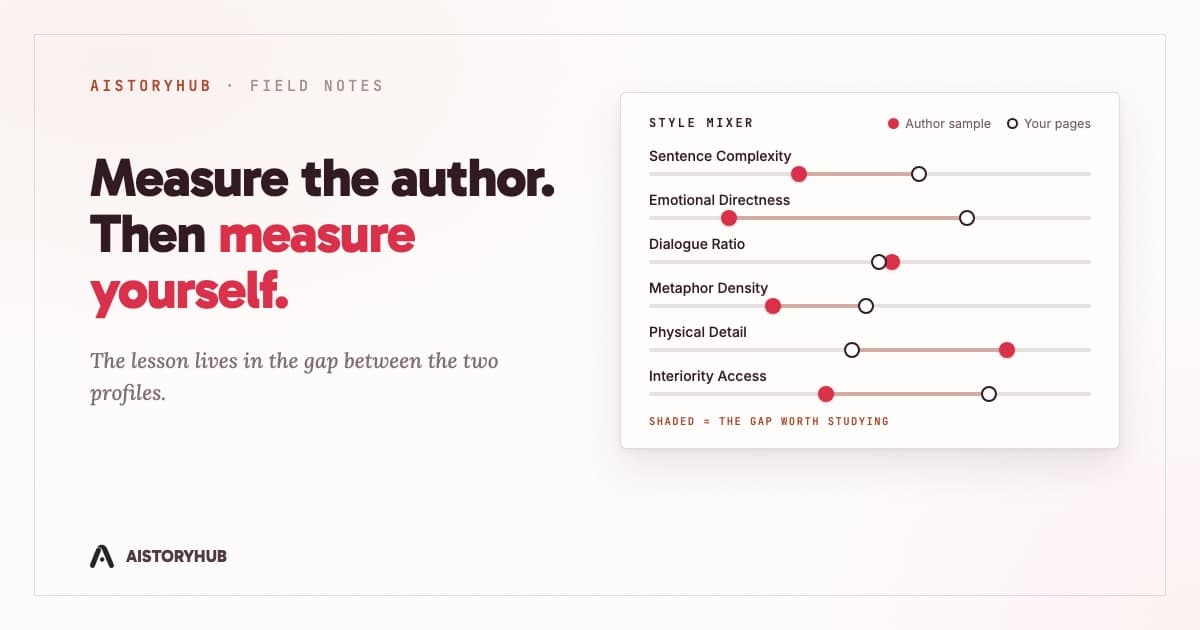
Writers have always learned by copying. Hunter S. Thompson famously retyped The Great Gatsby to feel how Fitzgerald built his sentences from the inside. Style Lab does a measured version of that exercise. You paste a sample, a model reads it at low temperature, and you get back a profile scored across Style Lab's dials: sentence complexity, emotional directness, dialogue ratio, metaphor density, and the rest.
What you don't get back is the author's text. The analysis saves the scores plus a generated name and short description. The sample you pasted isn't stored with the profile. That detail shapes both how useful this is and where the ethical lines sit, so I'll start there.
Learning versus imitation
Here's where I land, and you're welcome to land somewhere stricter.
Measuring an author to understand what they do is learning. Finding out that a writer you love keeps emotional directness low and physical detail high is the same kind of knowledge you'd get from a close reading in a workshop, just with numbers attached. Style, in the general sense of tendencies and habits, isn't something copyright protects. Specific text is.
Generating prose designed to be mistaken for a living author's work is a different activity, and I don't think a tool should help you sell it. The profile can't reproduce anyone's sentences, subject matter, or ideas, but it can push a model toward a recognizable texture. If you publish what comes out, the useful question is whether a reader who knows that author would think you were trying to pass as them. If yes, keep turning dials.
Two practical points. Paste from a book you own. And remember that the analysis runs on your own connected model, so the sample goes to your provider under their data terms, the same as anything else you send through your key. If that bothers you for a given book, pick a public-domain author: Austen, Wharton's early novels, or Hemingway's The Sun Also Rises, which entered the US public domain in 2022.
Step 1: choose the sample carefully
The analysis needs at least 1,500 words and accepts up to 12,000. We recommend 2,000 to 10,000. Within that range, what you choose matters more than how much.
- Take it from the middle of a book. Opening chapters are over-worked and often atypical. Chapter seven is closer to how the author writes when nobody is watching.
- Mix dialogue and narration. If you paste a page that is almost all quoted speech, dials like setting detail and interiority access have nothing to measure, and they'll come back near the middle by default.
- One book, not three. Writers change across a career. A sample stitched from an early and a late novel averages two styles into one that neither book has.
Step 2: run the analysis
In Style Lab (Voiceprint in the sidebar), create a new style and choose Text Analysis. It needs an AI key connected because it runs on whatever model you've set for prose generation, and it uses tokens from that key. The other path, the Style Mixer, is fully manual and needs no key. You'll use it in step four.
Paste the sample, wait for the counter to say it's ready, and run it. A couple of minutes later you have a profile with a generated name.
Step 3: read the result as a hypothesis
Treat every number as one model's opinion of one sample. Pick three or four dials where you already have a strong sense of the author, and check them. If an author you think of as relentlessly linear comes back high on time linearity (where high means fragmented, with flashbacks), believe your reading over the number. I wrote about exactly this failure, a model confidently scoring Hemingway as highly nonlinear, in the post about the 40-dimension experiments.
One known gap: the analysis scores thirty dials, and the last three in the mixer (numeric density, acronym tolerance, and mechanism surface) are always saved at 50. Set those by hand if they matter for the author. What a Voiceprint actually measures goes through every dial and why that gap exists.
Step 4: measure yourself, then mix
This is the step that turns imitation into learning. Run Text Analysis a second time on 2,000 or more words of your own writing. Now you have two profiles, and the interesting information is in the gaps between them.
Maybe the author sits at 20 on emotional directness and you sit at 70. That's a real, specific note: you name feelings that they leave to the reader. Maybe your dialogue ratio is nearly identical and nothing needs to change there. Write down the three biggest gaps. Those three are your lesson from this author, and they're more useful than any profile.
Then open the Style Mixer and build a third style by hand, setting every dial to your own numbers first. Move only the dials you decided to learn from, and move them partway. Keep everything else where you naturally sit. The result is a profile of you, nudged in a few directions you chose on purpose, which is a much better thing to write with than a copy of somebody else.
Step 5: pin it and test it
On the story's home page, the Voice Profile selector lets you pin a style to that story. Generation uses the pinned style first, and falls back to your account default if nothing is pinned. Ash's chat briefing picks up the same voice.
Test before you commit. Add a sandbox chapter and generate a scene you've already written yourself, so you have something to compare against. Read the two side by side. If the generated version overshoots on one of the dials you moved, pull it back. Sandbox chapters stay out of later chapters' generation context, so experiments here don't leak into the book.
What the dials can't carry
A profile captures tendencies. It doesn't capture what an author notices, which is most of why we love them. A writer who sits at 80 on physical detail is interesting because of which details, and no slider knows that. You still have to read them for that part.
Which is the real reason to do this exercise. You come out with numbers, but mostly you come out with three sentences about how a writer you admire differs from you, and a style that leans their way without pretending to be them. It's in Style Lab, under Voiceprint in the sidebar.