When someone shares an AI-drafted chapter that falls flat, the first note in the replies is almost always the same three words: show, don't tell. It's the oldest advice in any workshop, and for a human first draft it's often right. For a model's draft it's usually backwards. The model is already showing. It shows constantly, in every paragraph, and that's a big part of why the page feels dead.
Here's the kind of paragraph I mean. I wrote it to sound like a default draft, but every phrase in it is one I've seen come back from a real generation:
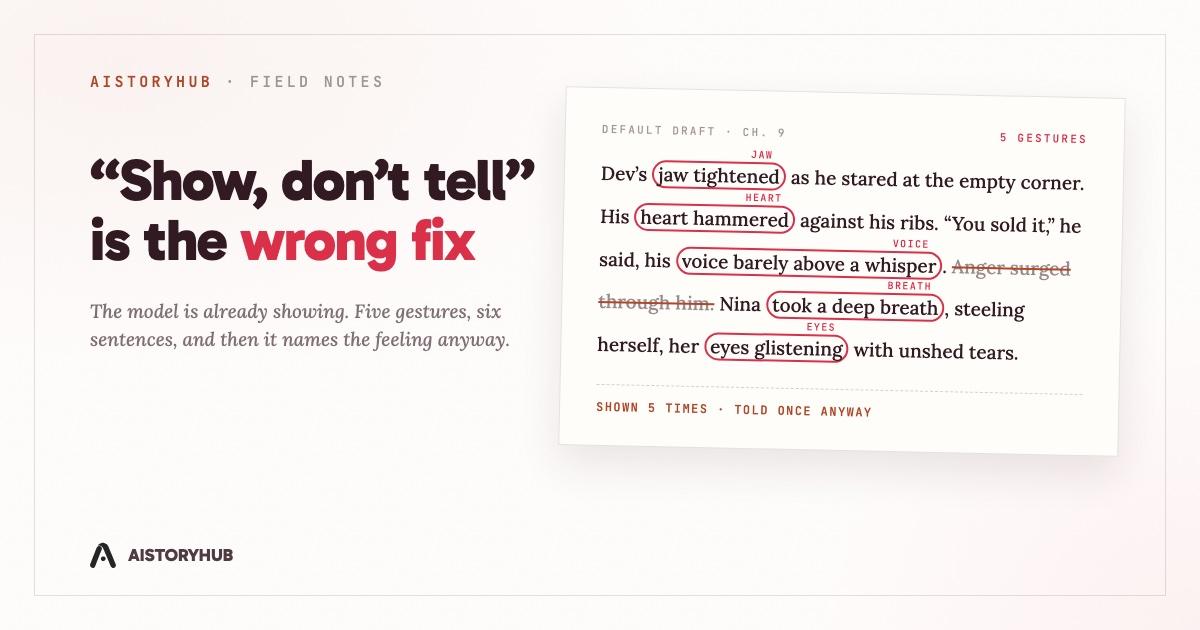
Dev's jaw tightened as he stared at the empty corner where the piano had stood. His heart hammered against his ribs. "You sold it," he said, his voice barely above a whisper. Anger surged through him, mixed with a grief he couldn't quite name. Nina took a deep breath, steeling herself. "I had to," she said, her eyes glistening with unshed tears.
Count the showing. A jaw, a heart, a voice, a breath, a pair of eyes. Five physical tells in six sentences. Then, in case you missed them, the paragraph tells you anyway: anger surged, grief he couldn't name. Workshop advice would flag the telling and leave the gestures alone. The gestures are the bigger problem.
The corpus has a whole shelf of these
Our cliché corpus (the public file behind the Slop Checker, at public/ai-cliches-corpus.json) has a subcategory called fiction body-language clichés. It holds 22 entries right now: heart hammered against her ribs, her breath caught in her throat, a shiver ran down her spine, brow furrowed in concentration, knuckles whitened, let out a breath she didn't know she was holding. A sibling subcategory, fiction emotional-beat clichés, holds another 10, and two of them sit in the red tier: a flicker of something akin to and renewed sense of purpose.
Read those two lists side by side and you can see the model's whole emotional toolkit. It has a body part for each feeling and a vague noun for the feelings it can't place. When it can't decide which, it uses both.
Why models over-show
Models learned "show, don't tell" the same way we did. It's all over the craft writing they trained on, and it's baked into the edited fiction they read. So when a scene calls for anger, the model reaches for the most common physical signal of anger in its training data. A tight jaw. Clenched fists. Those are the average of every angry character in every published novel, which makes them the most predictable choice available.
And a predictable gesture is just a label in a costume. "His jaw tightened" carries the same information as "he was angry," and the reader decodes it in the same instant. The sentence pretends to trust the reader and then hands over the answer. That's why a page full of hammering hearts reads as both overwritten and empty: lots of words, no inference left to make.
The double move in the Dev paragraph makes it worse. Gesture, then label, then often a line of dialogue that states the feeling a third time. The model hedges against being misunderstood, the way a nervous presenter repeats the point of every slide.
The rewrite
Same scene, same information, with the physiology taken out:
Dev stood in the corner where the piano had been. Four pale squares in the carpet, where its feet had pressed down for thirty years.
"Who bought it."
"A church in Hamilton."
"How much."
Nina told him. He took out his phone and did something with it, a calculation or a text, she couldn't tell, and he kept at it well past the point where either would have been finished.
Nobody's heart does anything. There's no named emotion. What's left is three things a model rarely produces on its own.
The first is a detail that belongs to this room only. Every empty corner in fiction is empty. The four pale squares are the mark of one specific piano in one specific house, and they tell you how long it was there without anyone saying "thirty years of memories."
The second is a choice. Dev asks about the price. That's a decision the character made, and it's ambiguous on purpose: it could be grief turned sideways into logistics, or it could be that he wanted the money. The reader has to decide, and deciding is what makes a reader lean in. The stock version made that decision for them, twice.
The third is behavior that runs too long. Looking at a phone is nothing. Looking at it past the point where the task would be done is something, and the scene never explains it. Nina's point of view registers it without decoding it. So does the reader.
So is telling fine now?
Sometimes, yes. Plain telling is underrated, especially for minor beats. "She was furious, and she said nothing for the rest of dinner" is a perfectly good sentence. It's honest about what it's doing, it takes one line, and it moves on. Where AI prose goes wrong is in spending a physical gesture on every emotional beat, at full volume, so that none of them stand out.
A rough rule I use: tell the small feelings, dramatize the big ones through choices, and save the body for moments where the body is actually the story. A panic attack is physical. Grief at a piano sale mostly isn't.
A revision pass for this
This works on your own drafts and on generated ones, and it takes about twenty minutes per chapter.
- Go through the chapter and highlight every body part attached to an emotion: jaw, heart, breath, throat, eyes, fists, knuckles, spine, stomach. Don't judge yet, just mark them.
- Count. If you have more than one every few hundred words, the chapter is running on gestures.
- For each one, ask what it tells the reader that a single plain word wouldn't. If the answer is nothing, it's a label. Cut it, or replace it with the plain word if the beat is minor.
- For the two or three beats in the chapter that actually matter, ask what this character would do that someone else in the same spot wouldn't. Write that instead. Usually it's a choice, a question they ask, or something they keep doing too long.
- Then check the dialogue right after each beat. If a character says the feeling out loud ("I'm so angry right now"), you probably don't need the gesture or the label in front of it either. Pick one carrier, not three.
The cut is the easy part. Most of the improvement comes from step four, which is also the step no find-and-replace can do for you.
Where a tool helps and where it stops
The phrase level is mechanical, so let a machine do it. Paste a chapter into the Slop Checker (free, no account) and it flags the stock gestures and emotional-beat phrases against the same corpus I quoted above, with each match tiered red, orange, or yellow by how strongly it signals machine prose. If you want the backstory on how that list got built, it's in We Catalogued 758 Phrases AI Can't Stop Writing.
What the checker can't tell you is whether a gesture is earned. "Her hands shook" is in no list, and it can be a cliché or the most important sentence in the book, depending on what came before. That judgment stays yours. The checker just clears the underbrush, so the gestures you keep are the ones you meant.